
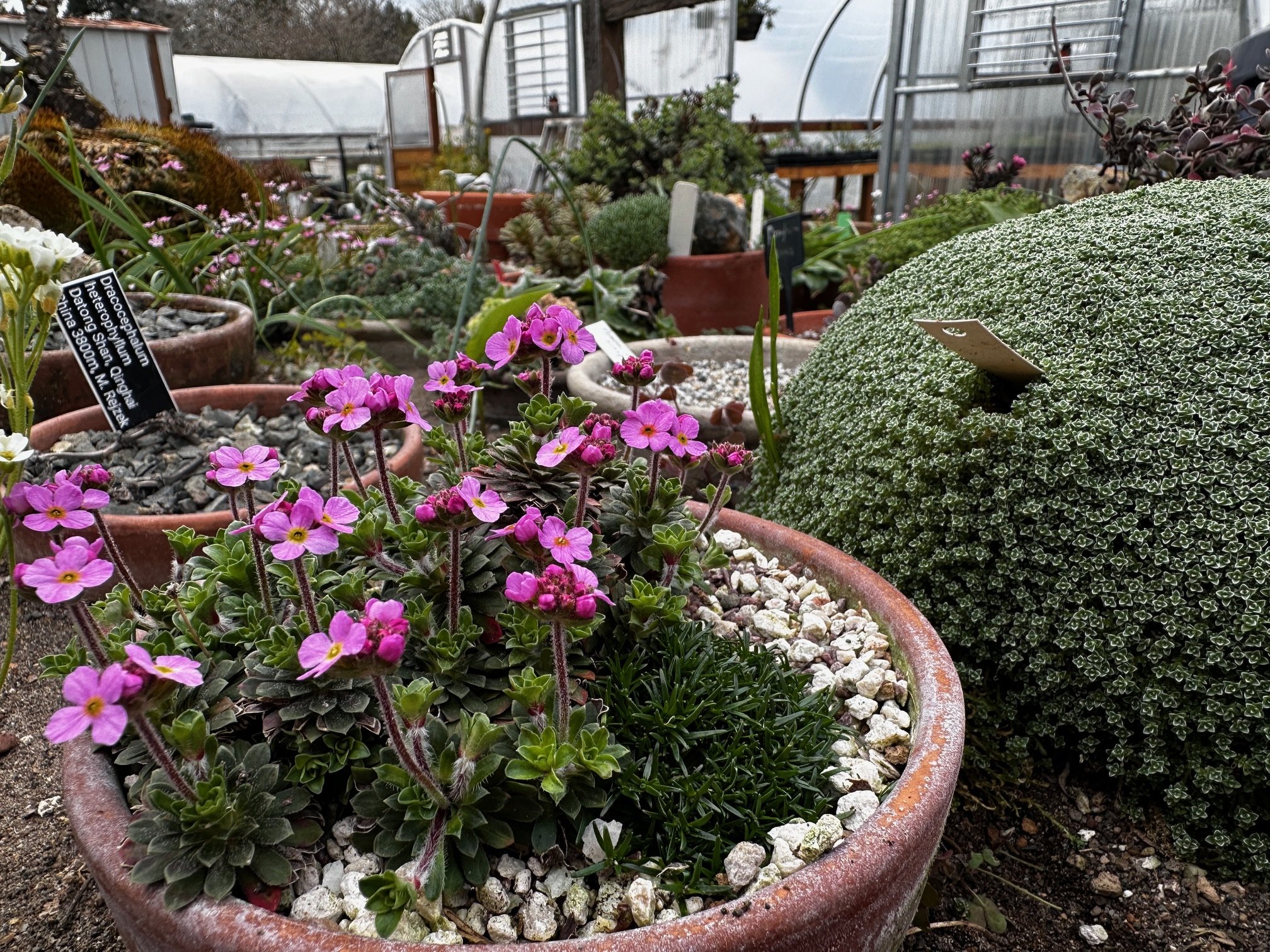
Androsace sempervivioides ‘Susan Joan’ forms exquisitely tight rosettes that knit together into slow, enduring mats of remarkable texture and precision. Each rosette, composed of small, fleshy, evergreen leaves, presses low against the substrate in a manner that evokes the highest alpine screes, where wind and cold dictate an architecture of absolute economy. Over time, these cushions mature into sculptural domes, dense yet finely articulated, with a surface that appears almost moss-like in its complexity.
In mid spring, the plant is briefly transformed as delicate stems rise just above the foliage, carrying soft pink, starry, yellow eyed blossoms that seem to float above the cushion surface. The contrast between the hard, living geometry of the foliage and the airy lightness of the flowers is central to its appeal, creating a moment of subtle drama that rewards close inspection rather than distance viewing.
In cultivation, ‘Susan Joan’ demands the most exacting conditions of the alpine repertoire: sharp drainage, a lean mineral substrate, and a cool, open exposure in full sun. I find it pretty easy in the open garden in a well drained sand bed, but it’s also at home in a trough, or pot, and I like to display a particularly lean grown specimen in the alpine frame. I’m sure it would thrive in a crevice garden.
Androsace sempervivioides ‘Susan Joan’ forms exquisitely tight rosettes that knit together into slow, enduring mats of remarkable texture and precision. Each rosette, composed of small, fleshy, evergreen leaves, presses low against the substrate in a manner that evokes the highest alpine screes, where wind and cold dictate an architecture of absolute economy. Over time, these cushions mature into sculptural domes, dense yet finely articulated, with a surface that appears almost moss-like in its complexity.
In mid spring, the plant is briefly transformed as delicate stems rise just above the foliage, carrying soft pink, starry, yellow eyed blossoms that seem to float above the cushion surface. The contrast between the hard, living geometry of the foliage and the airy lightness of the flowers is central to its appeal, creating a moment of subtle drama that rewards close inspection rather than distance viewing.
In cultivation, ‘Susan Joan’ demands the most exacting conditions of the alpine repertoire: sharp drainage, a lean mineral substrate, and a cool, open exposure in full sun. I find it pretty easy in the open garden in a well drained sand bed, but it’s also at home in a trough, or pot, and I like to display a particularly lean grown specimen in the alpine frame. I’m sure it would thrive in a crevice garden.