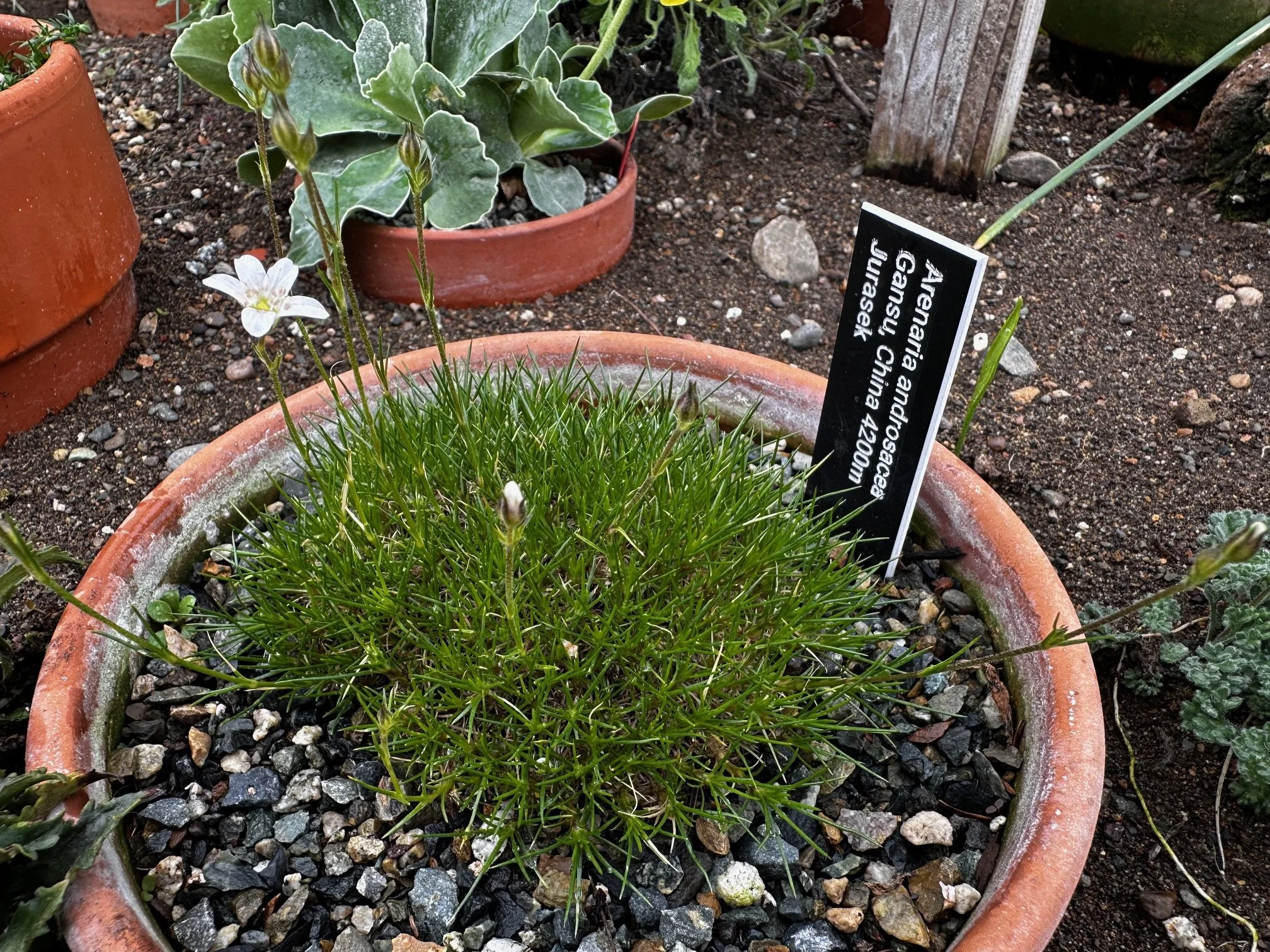
Arenaria androsacea is a diminutive, tufted perennial of high mountain and subalpine habitats in parts western Asia, where it inhabits rocky slopes, screes, and thin soils over limestone. This is a Jurasek collection from Gansu, China at 13,700’. It forms tight, cushion-like clumps of fine, linear to awl-shaped green leaves, creating a neat, low, grass-like presence well suited to the smallest spaces in the rock garden.
In late spring to early summer, it produces slender, wiry stems bearing small, starry white flowers with five deeply notched petals. Though individually delicate, the blooms are held just above the foliage in sufficient numbers to give a light, airy sprinkling of white across the plant. The effect is subtle but refined, especially when seen against the tight, textured foliage cushions.
Best grown in full sun and sharply drained, gritty or limestone-based soils, Arenaria androsacea thrives in alpine troughs, crevice gardens, and scree plantings where drainage is excellent and competition is minimal. It prefers cool root conditions and performs best in climates with cold winters and dry summers, showing reduced vigor in prolonged heat or humidity. I have been culturing mine in an alpine frame but I have enough know to experiment with it out in the garden.
Typically remaining under 2–4 inches tall, it expands slowly into low, persistent tufts that maintain their form year-round. Its combination of fine texture, restrained growth, and delicate floral display makes it a valuable plant for detailed alpine compositions and miniature rock garden plantings. Fantastic cushion plant.
I should try to make this catalog more botanical, so in an effort to do that, here is the listing from the wonderful e flora of china:
Herbs perennial. Roots robust; rootlets many. Stems pulvinate, with numerous branches, slender, 5--10 cm × ca. 1 mm, glabrous. Leaf blade linear-subulate, 0.5--1.5 cm × ca. 1 mm, margin slightly reflexed, apex spinose. Cymes 1--3-flowered; rachis densely glandular hairy; bracts ovate-lanceolate, 2--3 mm, margin broadly white scarious, apex acute. Pedicel densely glandular hairy. Sepals 5, ovate-lanceolate, 3--5 × 1--2 mm, glandular hairy abaxially, 1-veined, base broadened, margin narrowly membranous, apex acute. Petals 5, white, orbicular-obovate, longer than sepals, apex slightly undulate. Floral disc with 5 glands. Stamens 10; filaments equaling sepals. Ovary ovoid. Styles 3, ca. 2 mm. Capsule ovoid, slightly longer than persistent sepals, 3-valved; valves 2-cleft at apex. Fl. and fr. Jul--Sep
Arenaria androsacea is a diminutive, tufted perennial of high mountain and subalpine habitats in parts western Asia, where it inhabits rocky slopes, screes, and thin soils over limestone. This is a Jurasek collection from Gansu, China at 13,700’. It forms tight, cushion-like clumps of fine, linear to awl-shaped green leaves, creating a neat, low, grass-like presence well suited to the smallest spaces in the rock garden.
In late spring to early summer, it produces slender, wiry stems bearing small, starry white flowers with five deeply notched petals. Though individually delicate, the blooms are held just above the foliage in sufficient numbers to give a light, airy sprinkling of white across the plant. The effect is subtle but refined, especially when seen against the tight, textured foliage cushions.
Best grown in full sun and sharply drained, gritty or limestone-based soils, Arenaria androsacea thrives in alpine troughs, crevice gardens, and scree plantings where drainage is excellent and competition is minimal. It prefers cool root conditions and performs best in climates with cold winters and dry summers, showing reduced vigor in prolonged heat or humidity. I have been culturing mine in an alpine frame but I have enough know to experiment with it out in the garden.
Typically remaining under 2–4 inches tall, it expands slowly into low, persistent tufts that maintain their form year-round. Its combination of fine texture, restrained growth, and delicate floral display makes it a valuable plant for detailed alpine compositions and miniature rock garden plantings. Fantastic cushion plant.
I should try to make this catalog more botanical, so in an effort to do that, here is the listing from the wonderful e flora of china:
Herbs perennial. Roots robust; rootlets many. Stems pulvinate, with numerous branches, slender, 5--10 cm × ca. 1 mm, glabrous. Leaf blade linear-subulate, 0.5--1.5 cm × ca. 1 mm, margin slightly reflexed, apex spinose. Cymes 1--3-flowered; rachis densely glandular hairy; bracts ovate-lanceolate, 2--3 mm, margin broadly white scarious, apex acute. Pedicel densely glandular hairy. Sepals 5, ovate-lanceolate, 3--5 × 1--2 mm, glandular hairy abaxially, 1-veined, base broadened, margin narrowly membranous, apex acute. Petals 5, white, orbicular-obovate, longer than sepals, apex slightly undulate. Floral disc with 5 glands. Stamens 10; filaments equaling sepals. Ovary ovoid. Styles 3, ca. 2 mm. Capsule ovoid, slightly longer than persistent sepals, 3-valved; valves 2-cleft at apex. Fl. and fr. Jul--Sep