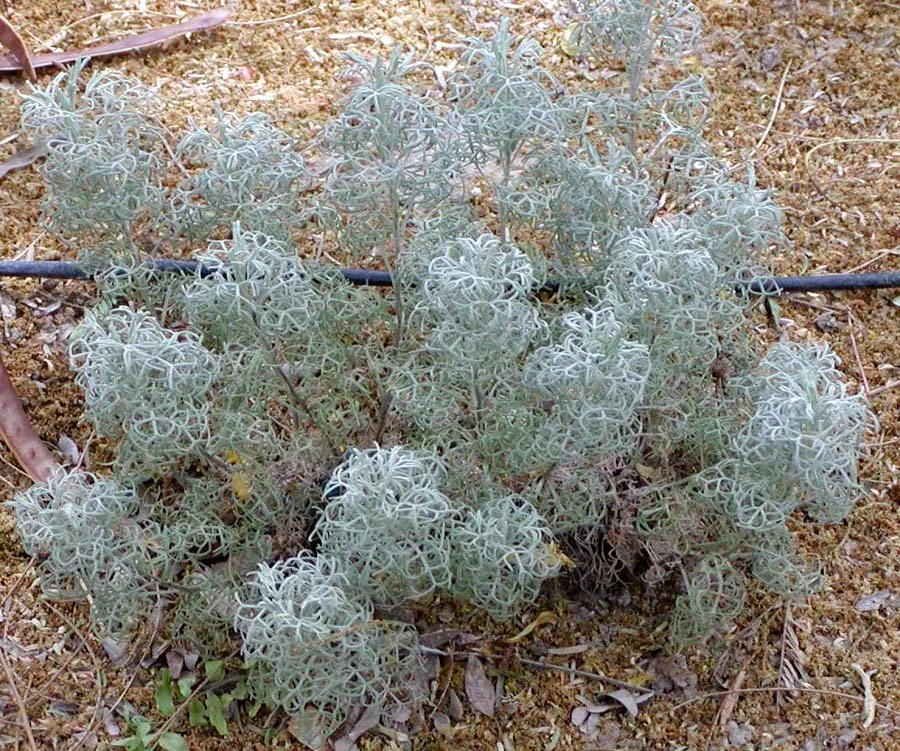
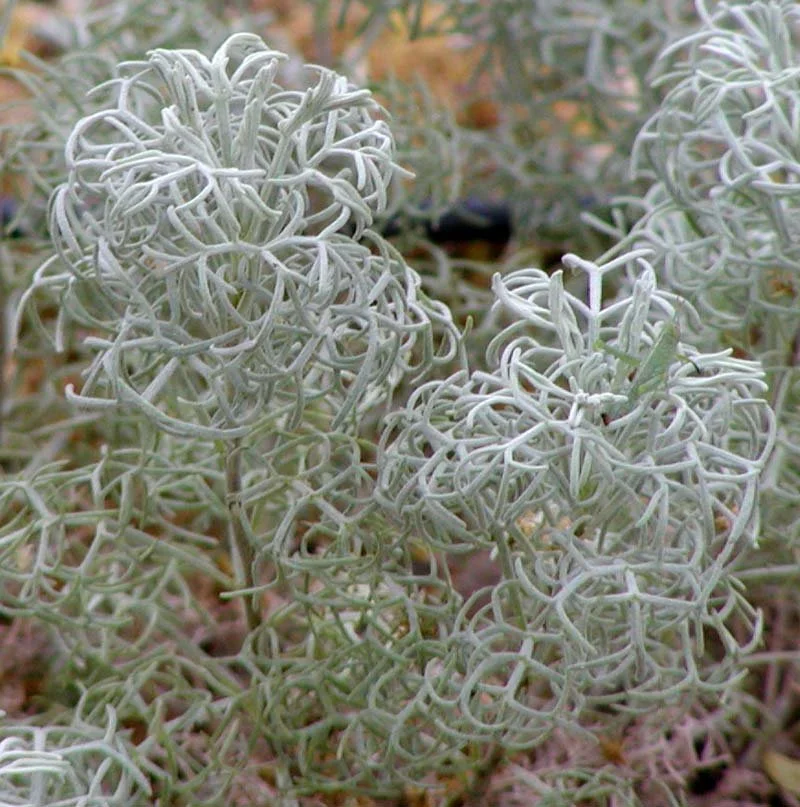
Another standout for the moon garden, or placed between dwarf conifers in the rock garden where the finely textured, soft, spreading mounds of intricately divided foliage in shimmering shades of silver-blue to sea-glass green can sparkle on a dark background. The finely cut leaves create a feathery, almost vaporous texture that reads as a continuous haze over the plant, giving it its aptly descriptive name. When brushed or crushed, the foliage releases a clean, resinous fragrance characteristic of the genus. Flowering is typically inconspicuous, with small, yellowish inflorescences that are usually removed or ignored in favor of the foliage effect.
This cultivar is derived from species native to arid and semi-arid regions of the western Himalaya and adjacent Asian highlands, where it is adapted to rocky slopes, screes, and open, sun-exposed habitats with sharply drained soils. Its coloration and fine texture reflect adaptation to intense sunlight and drought stress, where reflective leaf surfaces help reduce moisture loss.
In cultivation, ‘Seafoam’ is an outstanding foliage plant for rock gardens, gravel plantings, and dry borders. It requires full sun to maintain its compact form and best coloration, along with very sharp drainage and lean, mineral soils. Excess fertility or moisture will cause the plant to open up and lose its tight habit. Once established, it is highly drought tolerant and generally hardy to approximately USDA Zone 4–7, depending on drainage and winter wet conditions.
Valued primarily for its color and texture rather than its flowers, Artemisia versicolor ‘Seafoam’ provides a cool, luminous presence in the garden, pairing especially well with drought-tolerant perennials, dwarf conifers, alpine plants, and gravel-based plantings where its fine, drifting foliage can soften hard edges and unify composition.
Another standout for the moon garden, or placed between dwarf conifers in the rock garden where the finely textured, soft, spreading mounds of intricately divided foliage in shimmering shades of silver-blue to sea-glass green can sparkle on a dark background. The finely cut leaves create a feathery, almost vaporous texture that reads as a continuous haze over the plant, giving it its aptly descriptive name. When brushed or crushed, the foliage releases a clean, resinous fragrance characteristic of the genus. Flowering is typically inconspicuous, with small, yellowish inflorescences that are usually removed or ignored in favor of the foliage effect.
This cultivar is derived from species native to arid and semi-arid regions of the western Himalaya and adjacent Asian highlands, where it is adapted to rocky slopes, screes, and open, sun-exposed habitats with sharply drained soils. Its coloration and fine texture reflect adaptation to intense sunlight and drought stress, where reflective leaf surfaces help reduce moisture loss.
In cultivation, ‘Seafoam’ is an outstanding foliage plant for rock gardens, gravel plantings, and dry borders. It requires full sun to maintain its compact form and best coloration, along with very sharp drainage and lean, mineral soils. Excess fertility or moisture will cause the plant to open up and lose its tight habit. Once established, it is highly drought tolerant and generally hardy to approximately USDA Zone 4–7, depending on drainage and winter wet conditions.
Valued primarily for its color and texture rather than its flowers, Artemisia versicolor ‘Seafoam’ provides a cool, luminous presence in the garden, pairing especially well with drought-tolerant perennials, dwarf conifers, alpine plants, and gravel-based plantings where its fine, drifting foliage can soften hard edges and unify composition.