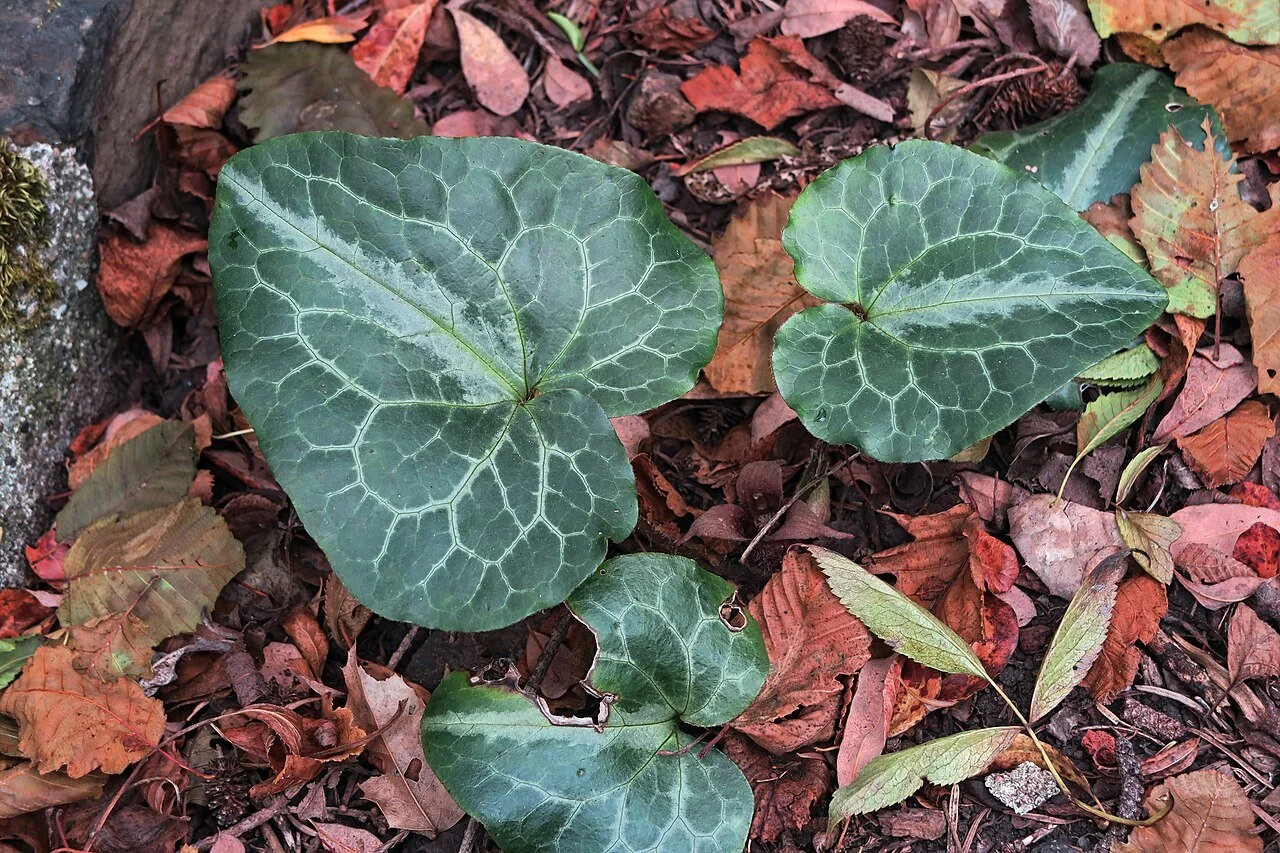
A beautiful and unusual western wild ginger, Asarum hartwegii forms compact clumps of heart-shaped, deep green leaves marked with striking silvery-white veining. The foliage is often softly hairy and can remain evergreen in mild climates, making this a particularly attractive plant for the woodland or shaded rock garden. Beneath the leaves, the curious spring flowers sit close to the ground, with reddish-brown outer surfaces and a distinctive pale interior marked with purple-red stripes. I grew these to be a prominant feature in the new shady pumice garden that we are working on this fall and I have a few extras to share.
Native to California, and southern Oregon from Roseburg south to the Klamath and Siskiyou Mountains, it grows in rocky slopes and open conifer and oak forests from about 150 to 2,200 meters. Despite its woodland origins, it can also be found in exposed gravelly and rocky sites, making it an excellent candidate for a shaded crevice or woodland rock garden. Give it humus-rich, well-drained soil with protection from hot afternoon sun and drying winds. It is a slow-growing, long-lived plant that is best allowed to establish undisturbed.
The unusual flowers of Asarum hartwegii have an equally unusual pollination strategy. Research has found that the flowers are capable of self-pollination but appear to retain adaptations associated with pollination by small flies and fungus gnats. This makes Hartweg's wild ginger an especially interesting plant for gardeners interested in the less obvious relationships between native plants and insects. Hardy to approximately Zone 6–9.
A beautiful and unusual western wild ginger, Asarum hartwegii forms compact clumps of heart-shaped, deep green leaves marked with striking silvery-white veining. The foliage is often softly hairy and can remain evergreen in mild climates, making this a particularly attractive plant for the woodland or shaded rock garden. Beneath the leaves, the curious spring flowers sit close to the ground, with reddish-brown outer surfaces and a distinctive pale interior marked with purple-red stripes. I grew these to be a prominant feature in the new shady pumice garden that we are working on this fall and I have a few extras to share.
Native to California, and southern Oregon from Roseburg south to the Klamath and Siskiyou Mountains, it grows in rocky slopes and open conifer and oak forests from about 150 to 2,200 meters. Despite its woodland origins, it can also be found in exposed gravelly and rocky sites, making it an excellent candidate for a shaded crevice or woodland rock garden. Give it humus-rich, well-drained soil with protection from hot afternoon sun and drying winds. It is a slow-growing, long-lived plant that is best allowed to establish undisturbed.
The unusual flowers of Asarum hartwegii have an equally unusual pollination strategy. Research has found that the flowers are capable of self-pollination but appear to retain adaptations associated with pollination by small flies and fungus gnats. This makes Hartweg's wild ginger an especially interesting plant for gardeners interested in the less obvious relationships between native plants and insects. Hardy to approximately Zone 6–9.