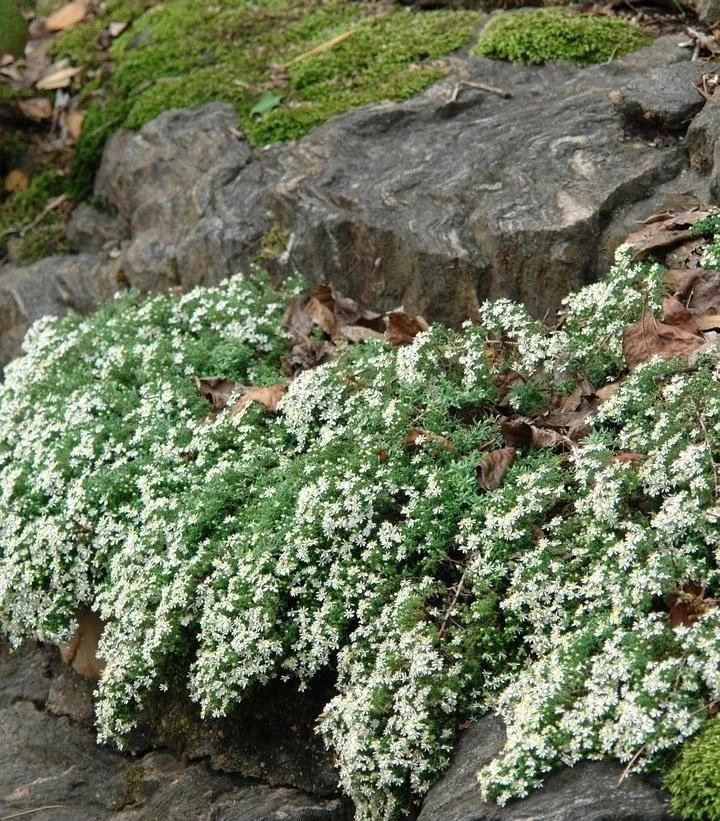
A graceful North American native with a remarkably airy habit, Aster ericoides—now generally treated botanically as Symphyotrichum ericoides—forms branching plants covered in narrow, heath-like foliage. From late summer into autumn, the stems become covered with masses of small white daisylike flowers with yellow centers, creating a cloud of bloom that is especially effective in a naturalistic or dry garden.
Widely distributed from Canada through much of the United States to Mexico, it is naturally found in open, dry to moist sites, including prairies, grasslands, rocky slopes, sandy ground, and other well-drained habitats. It is an excellent choice for a wildflower garden, gravel garden, or sunny rock garden and is remarkably tolerant of poor, dry, and even rocky soils.
One of its greatest garden virtues is its value to pollinators. The abundant late-season flowers provide nectar and pollen for bees, butterflies, flies, and other beneficial insects at a time when many other plants have finished flowering. It also serves as a larval host for several species of butterflies and moths. Hardy to approximately Zone 3–9.
Photo by North Creek Nursery
A graceful North American native with a remarkably airy habit, Aster ericoides—now generally treated botanically as Symphyotrichum ericoides—forms branching plants covered in narrow, heath-like foliage. From late summer into autumn, the stems become covered with masses of small white daisylike flowers with yellow centers, creating a cloud of bloom that is especially effective in a naturalistic or dry garden.
Widely distributed from Canada through much of the United States to Mexico, it is naturally found in open, dry to moist sites, including prairies, grasslands, rocky slopes, sandy ground, and other well-drained habitats. It is an excellent choice for a wildflower garden, gravel garden, or sunny rock garden and is remarkably tolerant of poor, dry, and even rocky soils.
One of its greatest garden virtues is its value to pollinators. The abundant late-season flowers provide nectar and pollen for bees, butterflies, flies, and other beneficial insects at a time when many other plants have finished flowering. It also serves as a larval host for several species of butterflies and moths. Hardy to approximately Zone 3–9.
Photo by North Creek Nursery