

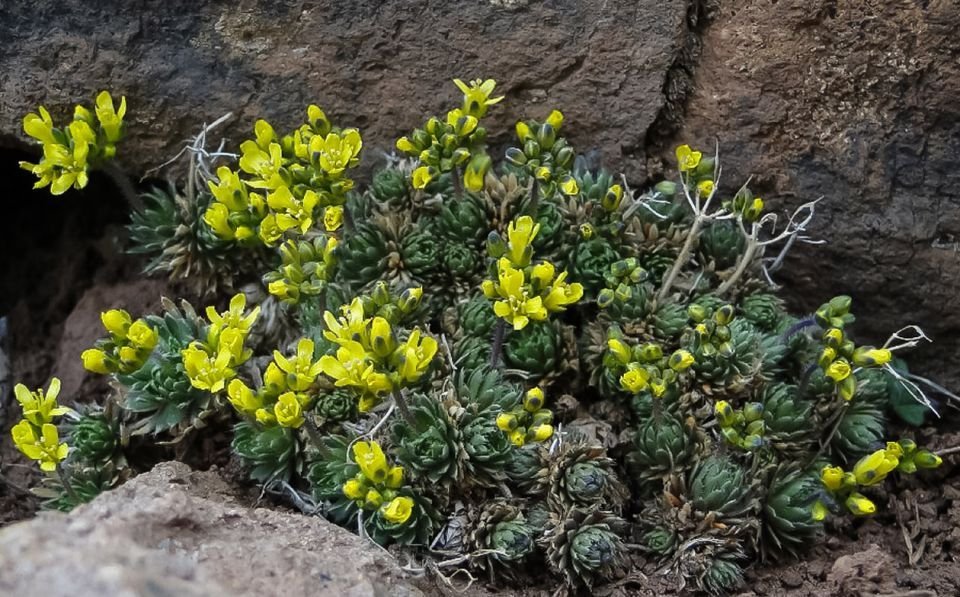
Draba hispanica is a diminutive, evergreen alpine perennial native to high, rocky habitats of the Pyrenees and other mountain ranges of the western Mediterranean region, where it grows in crevices, screes, and exposed limestone ledges. It forms tight, low cushions of small, fleshy, often slightly hairy leaves arranged in dense rosettes that create a compact, moss-like mat adapted to intense sun and wind.
In early to mid-spring, the plant produces short stems bearing clusters of bright yellow, four-petaled flowers typical of the mustard family. The bloom is surprisingly generous for such a small plant, often smothering the cushion in a luminous golden display that stands out vividly against the gray-green foliage. These early flowers are an important nectar source for cold-tolerant bees active in alpine environments.
Best grown in full sun and extremely well-drained, gritty or limestone-based soils, Draba hispanica thrives in rock crevices, trough gardens, and alpine screes where moisture drains quickly and competition is minimal. It is highly tolerant of cold and wind but requires protection from prolonged winter wet in milder climates.
Typically forming cushions only 1–3 inches tall, it expands slowly over time into tight, persistent mats. Its combination of extreme hardiness, compact habit, and brilliant early bloom makes it a classic subject for alpine and crevice gardens where detail and texture are appreciated at close range.
Draba hispanica is a diminutive, evergreen alpine perennial native to high, rocky habitats of the Pyrenees and other mountain ranges of the western Mediterranean region, where it grows in crevices, screes, and exposed limestone ledges. It forms tight, low cushions of small, fleshy, often slightly hairy leaves arranged in dense rosettes that create a compact, moss-like mat adapted to intense sun and wind.
In early to mid-spring, the plant produces short stems bearing clusters of bright yellow, four-petaled flowers typical of the mustard family. The bloom is surprisingly generous for such a small plant, often smothering the cushion in a luminous golden display that stands out vividly against the gray-green foliage. These early flowers are an important nectar source for cold-tolerant bees active in alpine environments.
Best grown in full sun and extremely well-drained, gritty or limestone-based soils, Draba hispanica thrives in rock crevices, trough gardens, and alpine screes where moisture drains quickly and competition is minimal. It is highly tolerant of cold and wind but requires protection from prolonged winter wet in milder climates.
Typically forming cushions only 1–3 inches tall, it expands slowly over time into tight, persistent mats. Its combination of extreme hardiness, compact habit, and brilliant early bloom makes it a classic subject for alpine and crevice gardens where detail and texture are appreciated at close range.