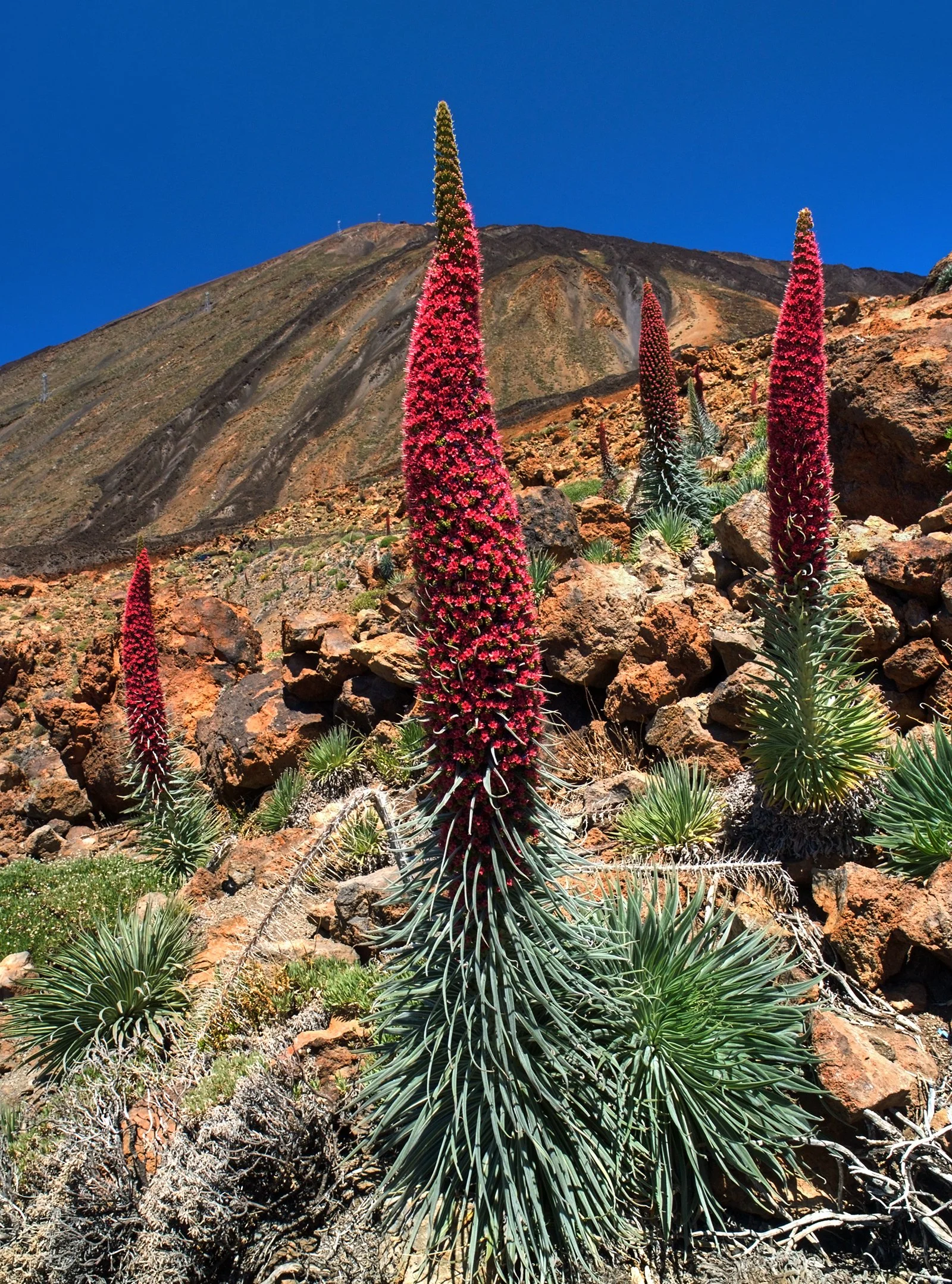
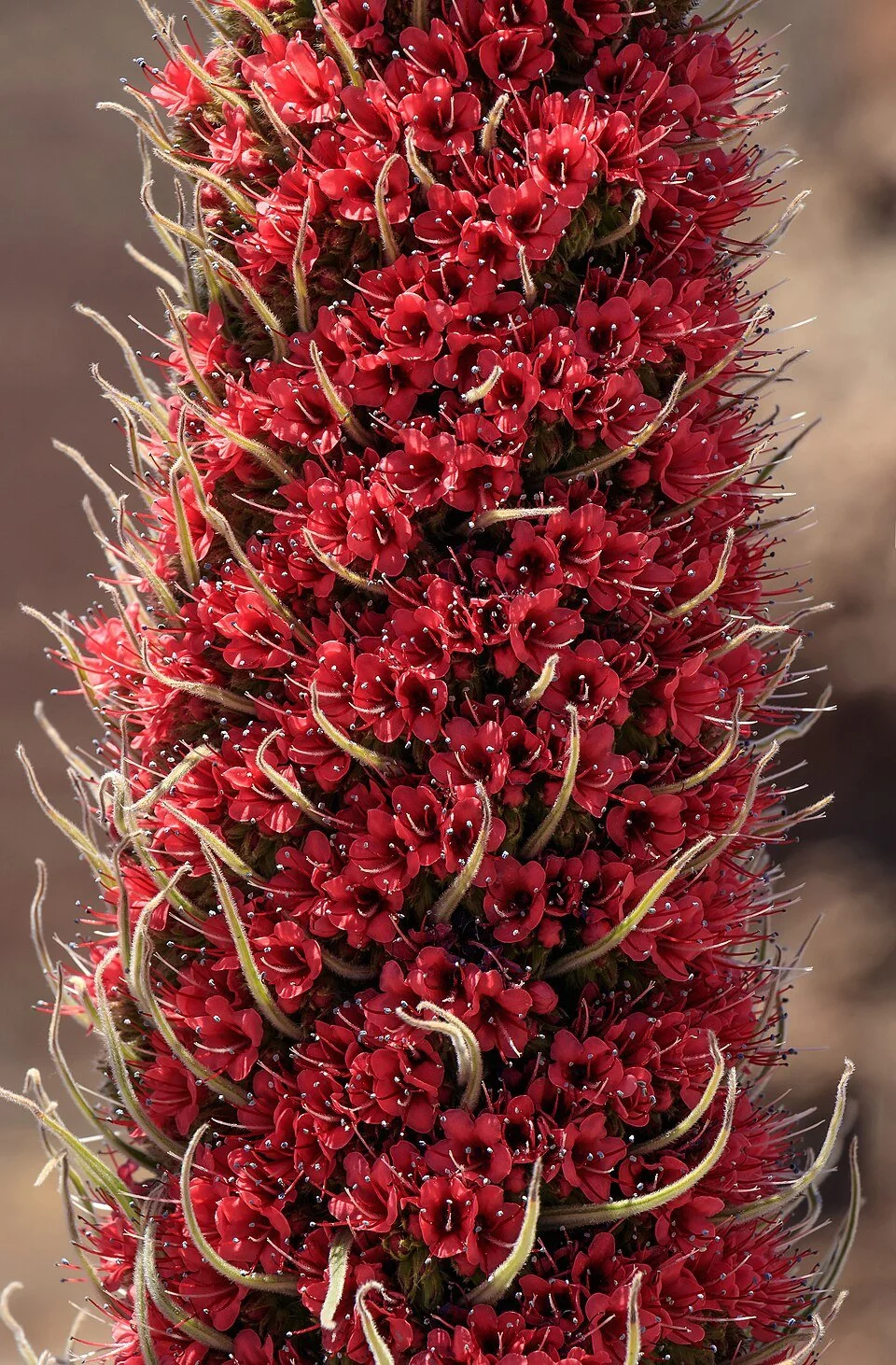
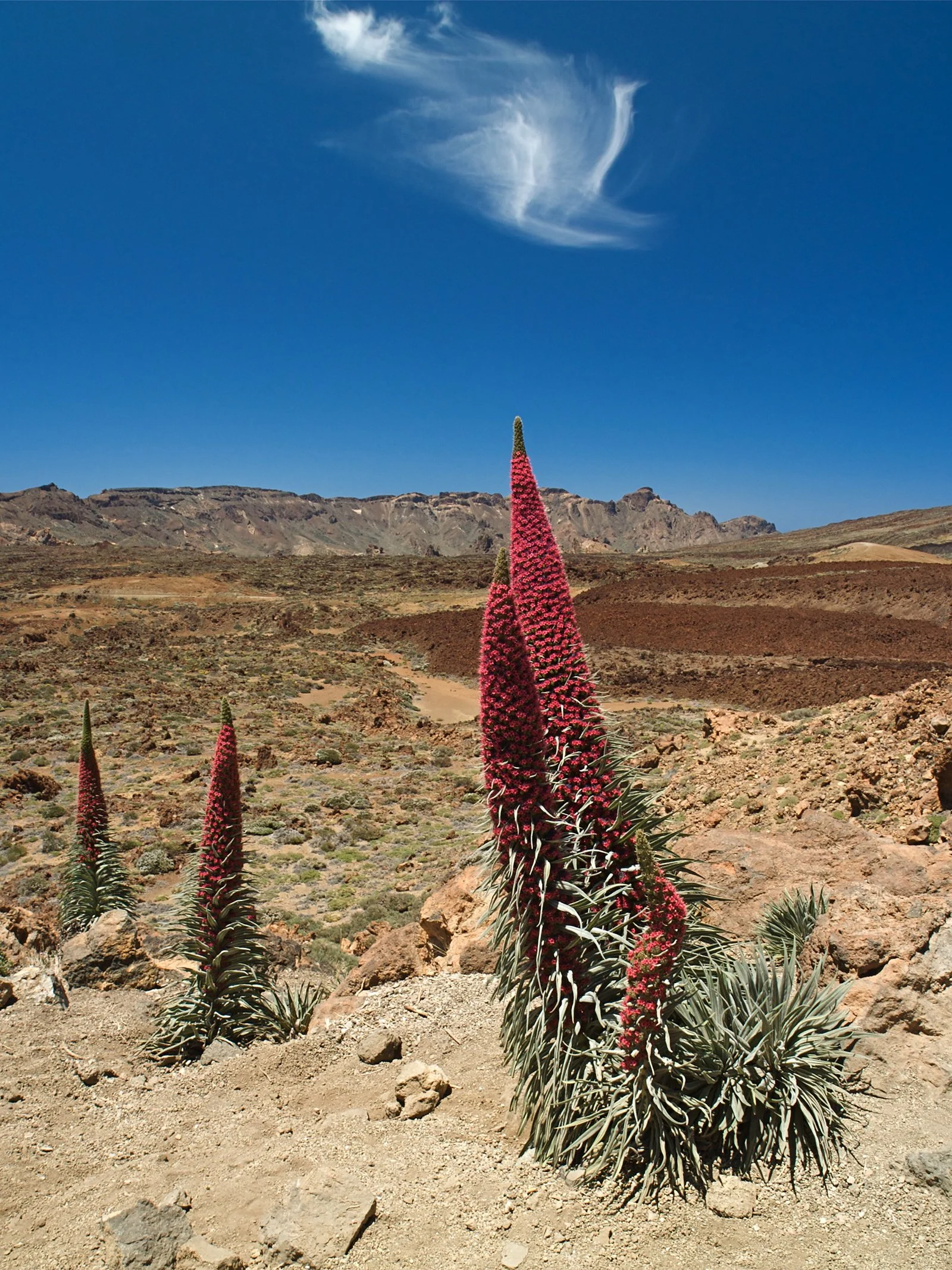
Known as the “Tower of Jewels,” Echium wildpretii is one of the most dramatic flowering plants of the Canary Islands, native to the volcanic slopes and high elevations of Tenerife. In its first season it forms a broad silver rosette of narrow, softly hairy leaves, followed in the second year by an immense flower spike that can rise 6–10 feet tall and is densely packed with thousands of vivid coral-red blossoms. The effect is so theatrical and improbable that one could almost imagine it discussed in the wardroom of HMS Surprise alongside the strange botanical marvels encountered in Patrick O’Brian’s Master and Commander novels. The towering blooms attract bees and other pollinators while creating an unforgettable architectural focal point in the garden. I love to think about those tall masted ships dotting the windward horizon with the deep blue sea, meeting the barren rugged slopes of Tenerife where this plant absolutely lights up the start landscape. The tower moniker is well given and it’s not one for the rock garden, and you may even ask why am I offering it since I specialize in tiny dwarf things, well, oddities are also my jam and maybe you can’t get this at your local garden center so here it is.
Despite its exotic appearance, this species is surprisingly adaptable in dry climates where drainage is excellent. It thrives in full sun and lean, gravelly soils, making it particularly effective in Mediterranean-style plantings, dry slopes, and bold rock garden settings. The silvery foliage remains attractive even before flowering, contrasting beautifully with agaves, aeoniums, and drought-tolerant perennials.
Best grown as a biennial or short-lived perennial, Echium wildpretii tolerates light frost but is generally hardy only to about USDA Zone 9. In colder climates it is often grown in containers, alpine houses, or protected gravel gardens where winter moisture can be controlled. Few plants equal its combination of sculptural foliage, towering floral display, and striking connection to the volcanic landscapes of the Canary Islands. I have certainly had a tough time getting most Echiums through the winter in our soggy Willamette Valley garden, where we often dip into the low teens in a cold winter but if you can protect this it is certainly one of the most striking of blooming plants in the kingdom.
Known as the “Tower of Jewels,” Echium wildpretii is one of the most dramatic flowering plants of the Canary Islands, native to the volcanic slopes and high elevations of Tenerife. In its first season it forms a broad silver rosette of narrow, softly hairy leaves, followed in the second year by an immense flower spike that can rise 6–10 feet tall and is densely packed with thousands of vivid coral-red blossoms. The effect is so theatrical and improbable that one could almost imagine it discussed in the wardroom of HMS Surprise alongside the strange botanical marvels encountered in Patrick O’Brian’s Master and Commander novels. The towering blooms attract bees and other pollinators while creating an unforgettable architectural focal point in the garden. I love to think about those tall masted ships dotting the windward horizon with the deep blue sea, meeting the barren rugged slopes of Tenerife where this plant absolutely lights up the start landscape. The tower moniker is well given and it’s not one for the rock garden, and you may even ask why am I offering it since I specialize in tiny dwarf things, well, oddities are also my jam and maybe you can’t get this at your local garden center so here it is.
Despite its exotic appearance, this species is surprisingly adaptable in dry climates where drainage is excellent. It thrives in full sun and lean, gravelly soils, making it particularly effective in Mediterranean-style plantings, dry slopes, and bold rock garden settings. The silvery foliage remains attractive even before flowering, contrasting beautifully with agaves, aeoniums, and drought-tolerant perennials.
Best grown as a biennial or short-lived perennial, Echium wildpretii tolerates light frost but is generally hardy only to about USDA Zone 9. In colder climates it is often grown in containers, alpine houses, or protected gravel gardens where winter moisture can be controlled. Few plants equal its combination of sculptural foliage, towering floral display, and striking connection to the volcanic landscapes of the Canary Islands. I have certainly had a tough time getting most Echiums through the winter in our soggy Willamette Valley garden, where we often dip into the low teens in a cold winter but if you can protect this it is certainly one of the most striking of blooming plants in the kingdom.