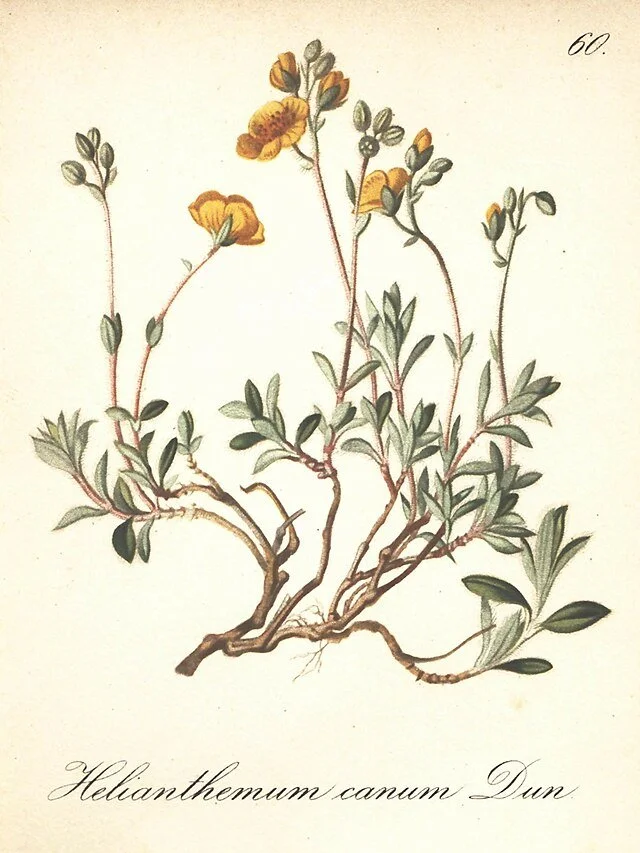
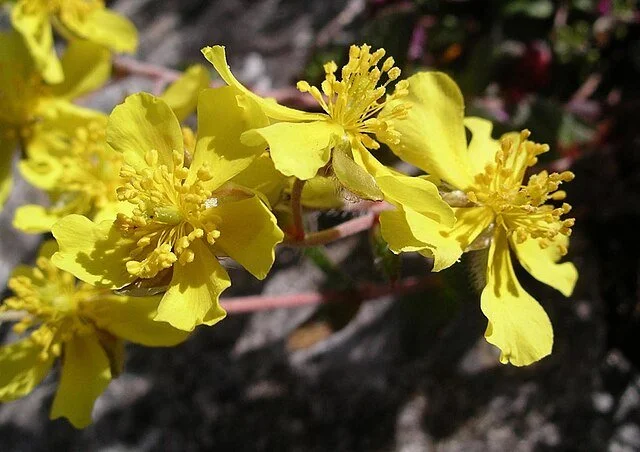
Helianthemum canum (grey sunrose) is a low, woody, mat-forming subshrub native to mountainous regions of southern and central Europe, where it inhabits dry, sun-exposed limestone slopes, rocky outcrops, screes, and alpine grasslands. Its naturally compact, trailing habit is clothed in small, grey-green, softly pubescent leaves that give the plant a muted, silvery presence even when not in bloom. In late spring to early summer it produces abundant, five-petaled, butter-yellow flowers that open in the sun and create a bright contrast against its cool-toned foliage.
In cultivation, Helianthemum canum is an excellent rock garden and scree plant, especially well suited to lime-rich, sharply drained soils and hot, exposed positions. It thrives in full sun and performs best in lean, mineral soils with excellent drainage, where its natural drought tolerance can be fully expressed. Once established, it is reliably hardy in USDA Zones 5–7, though its longevity is closely tied to winter drainage rather than minimum temperature. It is particularly valuable for dry stone walls, gravel gardens, and alpine troughs, where its low, spreading habit can spill naturally over stones and its spring bloom brings a concentrated burst of alpine light.
Helianthemum canum (grey sunrose) is a low, woody, mat-forming subshrub native to mountainous regions of southern and central Europe, where it inhabits dry, sun-exposed limestone slopes, rocky outcrops, screes, and alpine grasslands. Its naturally compact, trailing habit is clothed in small, grey-green, softly pubescent leaves that give the plant a muted, silvery presence even when not in bloom. In late spring to early summer it produces abundant, five-petaled, butter-yellow flowers that open in the sun and create a bright contrast against its cool-toned foliage.
In cultivation, Helianthemum canum is an excellent rock garden and scree plant, especially well suited to lime-rich, sharply drained soils and hot, exposed positions. It thrives in full sun and performs best in lean, mineral soils with excellent drainage, where its natural drought tolerance can be fully expressed. Once established, it is reliably hardy in USDA Zones 5–7, though its longevity is closely tied to winter drainage rather than minimum temperature. It is particularly valuable for dry stone walls, gravel gardens, and alpine troughs, where its low, spreading habit can spill naturally over stones and its spring bloom brings a concentrated burst of alpine light.