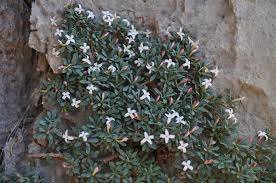
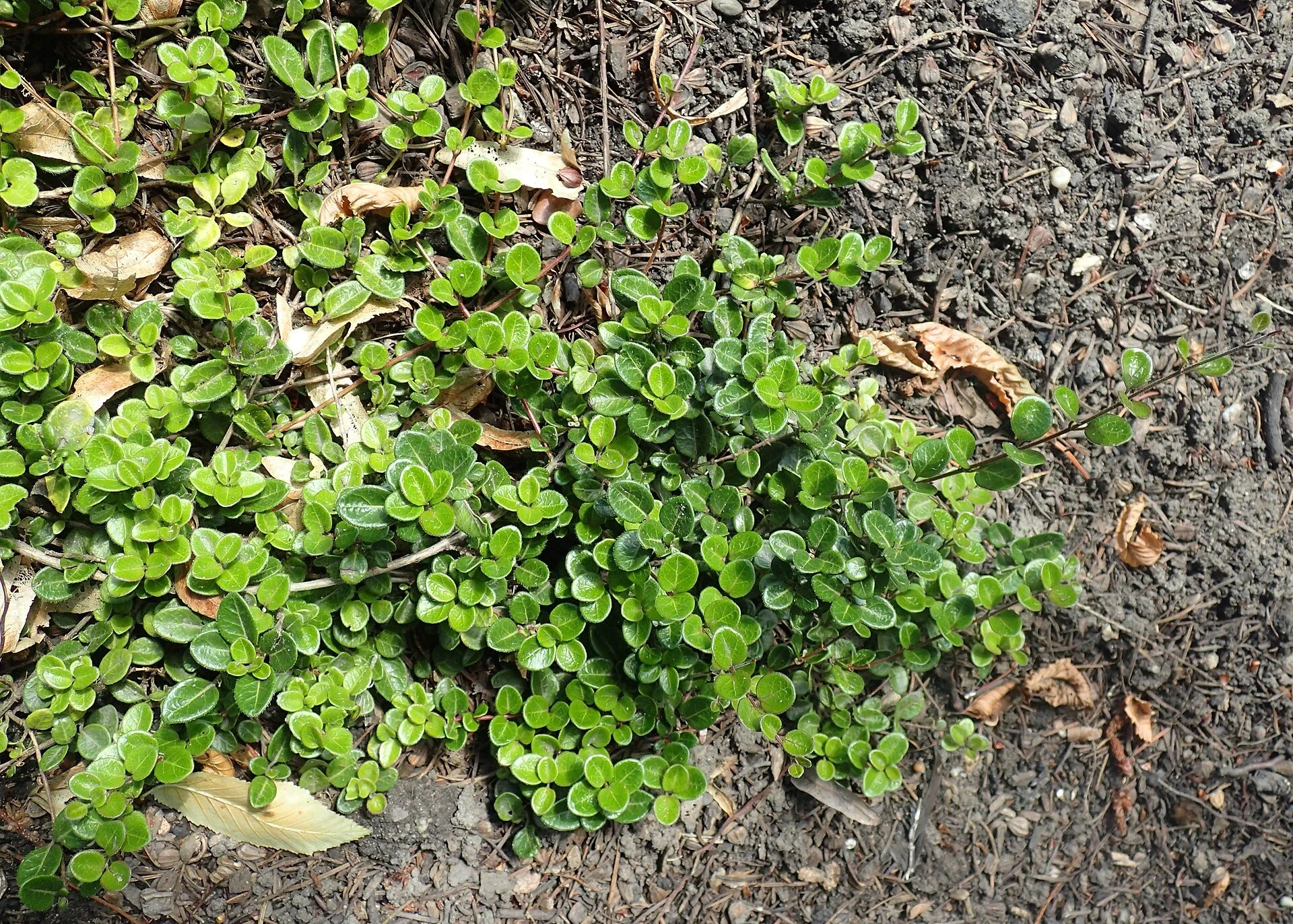
Lonicera crassifolia is a low, creeping evergreen honeysuckle native to mountainous regions of China, where it grows on rocky slopes, cliffs, and forest margins. Unlike its vining relatives, this species forms a dense, mat-like shrub with wiry stems that root as they spread, creating a tight, weed-suppressing groundcover over time. The small, thick, glossy leaves are rounded to oval and closely spaced along the stems, giving the plant a refined, textured appearance year-round.
I saw it in trough in the garden of Vancouver Islands, Janice Currie and it was the best I ever saw. Tight congested mats just smothering the rocks. I do think this one wants to be grown lean to keep it very tight.
In late spring to early summer, it produces small but charming tubular flowers, typically creamy yellow to soft pink, often followed by translucent red berries that add seasonal interest and attract birds. It performs best in well-drained soils with average fertility and is especially valuable in rock gardens, troughs, walls, and slopes where it can cascade naturally over stone.
Hardy in USDA Zones 5–8, Lonicera crassifolia is appreciated for its adaptability, fine texture, and ability to knit together dry, difficult areas into a living green carpet with subtle seasonal color shifts.
Lonicera crassifolia is a low, creeping evergreen honeysuckle native to mountainous regions of China, where it grows on rocky slopes, cliffs, and forest margins. Unlike its vining relatives, this species forms a dense, mat-like shrub with wiry stems that root as they spread, creating a tight, weed-suppressing groundcover over time. The small, thick, glossy leaves are rounded to oval and closely spaced along the stems, giving the plant a refined, textured appearance year-round.
I saw it in trough in the garden of Vancouver Islands, Janice Currie and it was the best I ever saw. Tight congested mats just smothering the rocks. I do think this one wants to be grown lean to keep it very tight.
In late spring to early summer, it produces small but charming tubular flowers, typically creamy yellow to soft pink, often followed by translucent red berries that add seasonal interest and attract birds. It performs best in well-drained soils with average fertility and is especially valuable in rock gardens, troughs, walls, and slopes where it can cascade naturally over stone.
Hardy in USDA Zones 5–8, Lonicera crassifolia is appreciated for its adaptability, fine texture, and ability to knit together dry, difficult areas into a living green carpet with subtle seasonal color shifts.