
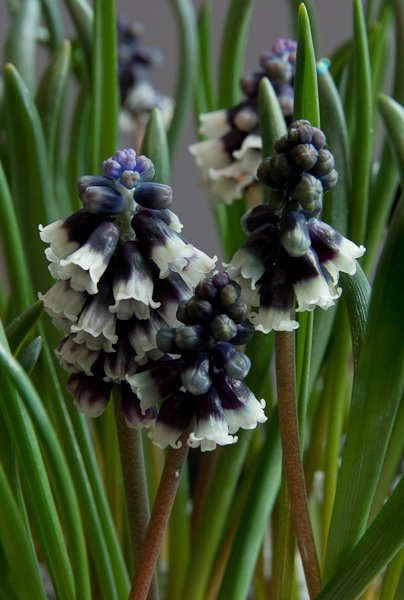
A rare and highly distinctive grape hyacinth from the mountains of the eastern Mediterranean and Turkish Steppe, Muscari discolor is prized by collectors for its unusual bicolored flowers and elegant proportions. In early spring, compact spikes of tightly packed urn-shaped blossoms emerge above narrow, upright foliage. The lower flower bells are wonderfully rimmed with white, and darken to solid as you go up the stalk to the unbloomed inflorescence.
Native to rocky slopes, steppe, and alpine meadows, M. discolor has a refined, delicate appearance compared with many of the more vigorous grape hyacinths. Its narrow, slightly glaucous leaves appear in late winter and remain attractive through the flowering season before retreating into summer dormancy.
This uncommon species is ideal for the rock garden, alpine trough, bulb frame, or a sunny, well-drained border where its intricate flowers can be appreciated at close range. Like many Mediterranean bulbs, it prefers a gritty, mineral soil with moisture during winter and spring growth followed by a warm, dry summer rest.
A true collector's grape hyacinth, Muscari discolor offers exceptional floral detail and a color combination rarely seen among spring-flowering bulbs. Its understated beauty makes it a wonderful addition for gardeners interested in botanical diversity and unusual geophytes.
Height: 4–8 in. (10–20 cm)
Bloom Season: Early to mid-spring
Hardiness: USDA Zones 5–8
Culture: Full sun to light shade; sharply drained, gritty soil; winter and spring moisture followed by summer dormancy.
A rare and highly distinctive grape hyacinth from the mountains of the eastern Mediterranean and Turkish Steppe, Muscari discolor is prized by collectors for its unusual bicolored flowers and elegant proportions. In early spring, compact spikes of tightly packed urn-shaped blossoms emerge above narrow, upright foliage. The lower flower bells are wonderfully rimmed with white, and darken to solid as you go up the stalk to the unbloomed inflorescence.
Native to rocky slopes, steppe, and alpine meadows, M. discolor has a refined, delicate appearance compared with many of the more vigorous grape hyacinths. Its narrow, slightly glaucous leaves appear in late winter and remain attractive through the flowering season before retreating into summer dormancy.
This uncommon species is ideal for the rock garden, alpine trough, bulb frame, or a sunny, well-drained border where its intricate flowers can be appreciated at close range. Like many Mediterranean bulbs, it prefers a gritty, mineral soil with moisture during winter and spring growth followed by a warm, dry summer rest.
A true collector's grape hyacinth, Muscari discolor offers exceptional floral detail and a color combination rarely seen among spring-flowering bulbs. Its understated beauty makes it a wonderful addition for gardeners interested in botanical diversity and unusual geophytes.
Height: 4–8 in. (10–20 cm)
Bloom Season: Early to mid-spring
Hardiness: USDA Zones 5–8
Culture: Full sun to light shade; sharply drained, gritty soil; winter and spring moisture followed by summer dormancy.