
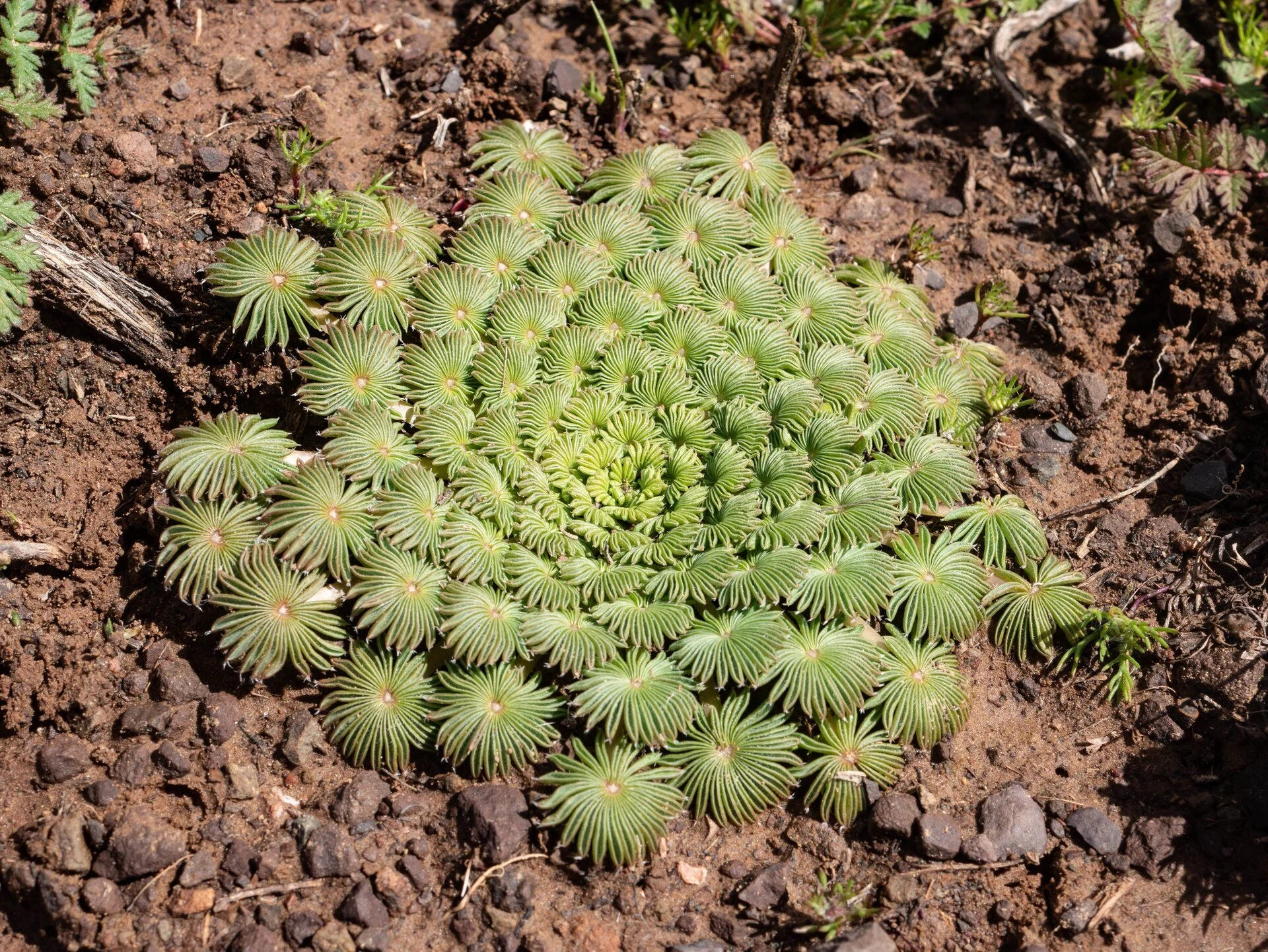
Among the most visually arresting of South African geophytes, Oxalis palmifrons forms perfect radial rosettes of flattened, palm-like leaflets that appear almost architectural in their precision. Each season’s growth emerges from a small subterranean bulb, unfurling into concentric rings of silvery-green segments that lie close to the ground like living mandalas. The effect is at once exotic and geometric, a plant that seems more constructed than grown, yet is entirely the product of evolutionary adaptation to a harsh, winter-rainfall climate.
In cultivation, Oxalis palmifrons is best appreciated in a well-drained, sharply mineral substrate where its seasonal rhythm can proceed undisturbed. Actively growing in the cool, moist months, it demands bright light and careful watering during its growth period, followed by a dry, dormant summer when the foliage naturally retreats. It is particularly well suited to alpine houses, bulb frames, or containers where its dormancy requirements can be controlled. In the rock garden, it requires exceptional drainage and a dry summer position, often performing best in trough or pot culture where its delicate structure can be observed at close range.
Hardy only to mild frost and intolerant of prolonged freezing, It has done very well for me in the bulb house which can routinley get into the teens through the winter, but the foliage is kept dry. In the right conditions, Oxalis palmifrons rewards with a display unlike any other bulbous plant—quiet, symmetrical, and mesmerizing in its architectural simplicity, a living expression of order emerging from austerity.
Among the most visually arresting of South African geophytes, Oxalis palmifrons forms perfect radial rosettes of flattened, palm-like leaflets that appear almost architectural in their precision. Each season’s growth emerges from a small subterranean bulb, unfurling into concentric rings of silvery-green segments that lie close to the ground like living mandalas. The effect is at once exotic and geometric, a plant that seems more constructed than grown, yet is entirely the product of evolutionary adaptation to a harsh, winter-rainfall climate.
In cultivation, Oxalis palmifrons is best appreciated in a well-drained, sharply mineral substrate where its seasonal rhythm can proceed undisturbed. Actively growing in the cool, moist months, it demands bright light and careful watering during its growth period, followed by a dry, dormant summer when the foliage naturally retreats. It is particularly well suited to alpine houses, bulb frames, or containers where its dormancy requirements can be controlled. In the rock garden, it requires exceptional drainage and a dry summer position, often performing best in trough or pot culture where its delicate structure can be observed at close range.
Hardy only to mild frost and intolerant of prolonged freezing, It has done very well for me in the bulb house which can routinley get into the teens through the winter, but the foliage is kept dry. In the right conditions, Oxalis palmifrons rewards with a display unlike any other bulbous plant—quiet, symmetrical, and mesmerizing in its architectural simplicity, a living expression of order emerging from austerity.