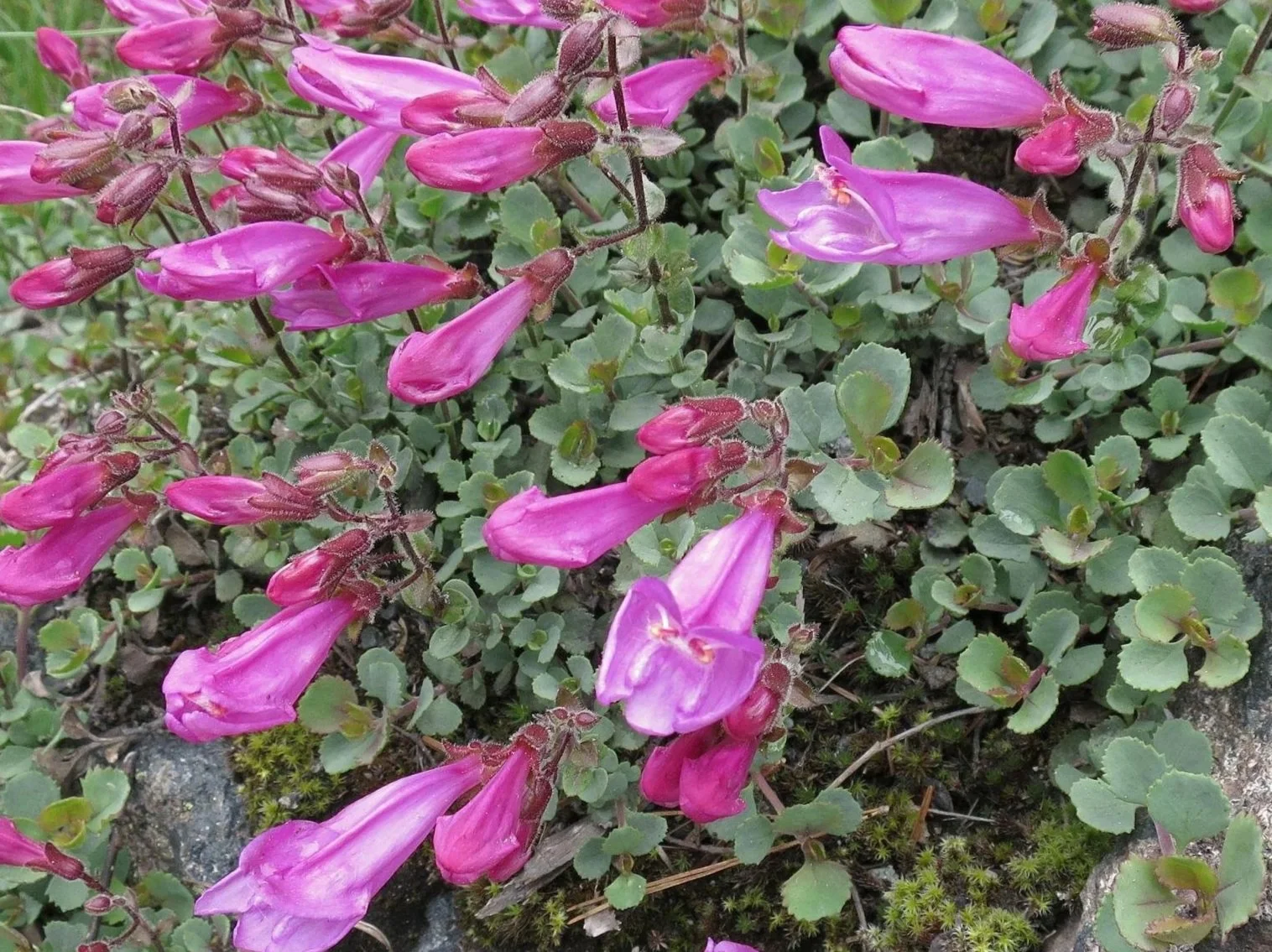
I got this selection from Rick Lupp the last time I visited him. It’s a super compact version of our native cliff dwelling hot pink beard tongue. The tiny little glaucus blue leaves have a nice bit of saw tooth edging to them, but the real standout feature is it’s compact form.
I don’t know who named it for her, and have to do a lot more reading, but Myrtle Hebert was involved in the early American Rock Garden Society and thanks to Claire Cockroft and Christine Ebrahimi for digging up this gem of an American Penstemon Society bulletin with this snippet that might explain some of the orgins of this lovely little Penstemon:
“I brought in a piece of newberryi from the hills, -and now it must cover a couple of, 'square inches. AnyWay it looks healthy if not enthusiastic. Davidsonii, also collected, Margaret and I could not find~ , But I do have a dozen or so of seedlings from Myrtles hybrid dasanthera and one from Levandeurs six hills hyrbids•. ,Most of them were put in the light Shade of a juniper for protection. They were in heavy shade when I got home and while healthy had no show of bloom. But I put three out in the. open, and they both grew and bloomed I think most of the “blood” is cardwelii and fruticosus .. · Roy thinks there ,may even be some rupicola ..” APS bulletin 26 1997
I lost it in a pot that was in the unheated greenhouse, but it’s managed to stay alive through cuttings, it does seem a bit more sensitive to excessive moisture than the straight species. I plan to put some out in the wall this spring to see how they do. If it has been around since 1967 it’s definitely a survivor so get one and keep it going.
I got this selection from Rick Lupp the last time I visited him. It’s a super compact version of our native cliff dwelling hot pink beard tongue. The tiny little glaucus blue leaves have a nice bit of saw tooth edging to them, but the real standout feature is it’s compact form.
I don’t know who named it for her, and have to do a lot more reading, but Myrtle Hebert was involved in the early American Rock Garden Society and thanks to Claire Cockroft and Christine Ebrahimi for digging up this gem of an American Penstemon Society bulletin with this snippet that might explain some of the orgins of this lovely little Penstemon:
“I brought in a piece of newberryi from the hills, -and now it must cover a couple of, 'square inches. AnyWay it looks healthy if not enthusiastic. Davidsonii, also collected, Margaret and I could not find~ , But I do have a dozen or so of seedlings from Myrtles hybrid dasanthera and one from Levandeurs six hills hyrbids•. ,Most of them were put in the light Shade of a juniper for protection. They were in heavy shade when I got home and while healthy had no show of bloom. But I put three out in the. open, and they both grew and bloomed I think most of the “blood” is cardwelii and fruticosus .. · Roy thinks there ,may even be some rupicola ..” APS bulletin 26 1997
I lost it in a pot that was in the unheated greenhouse, but it’s managed to stay alive through cuttings, it does seem a bit more sensitive to excessive moisture than the straight species. I plan to put some out in the wall this spring to see how they do. If it has been around since 1967 it’s definitely a survivor so get one and keep it going.