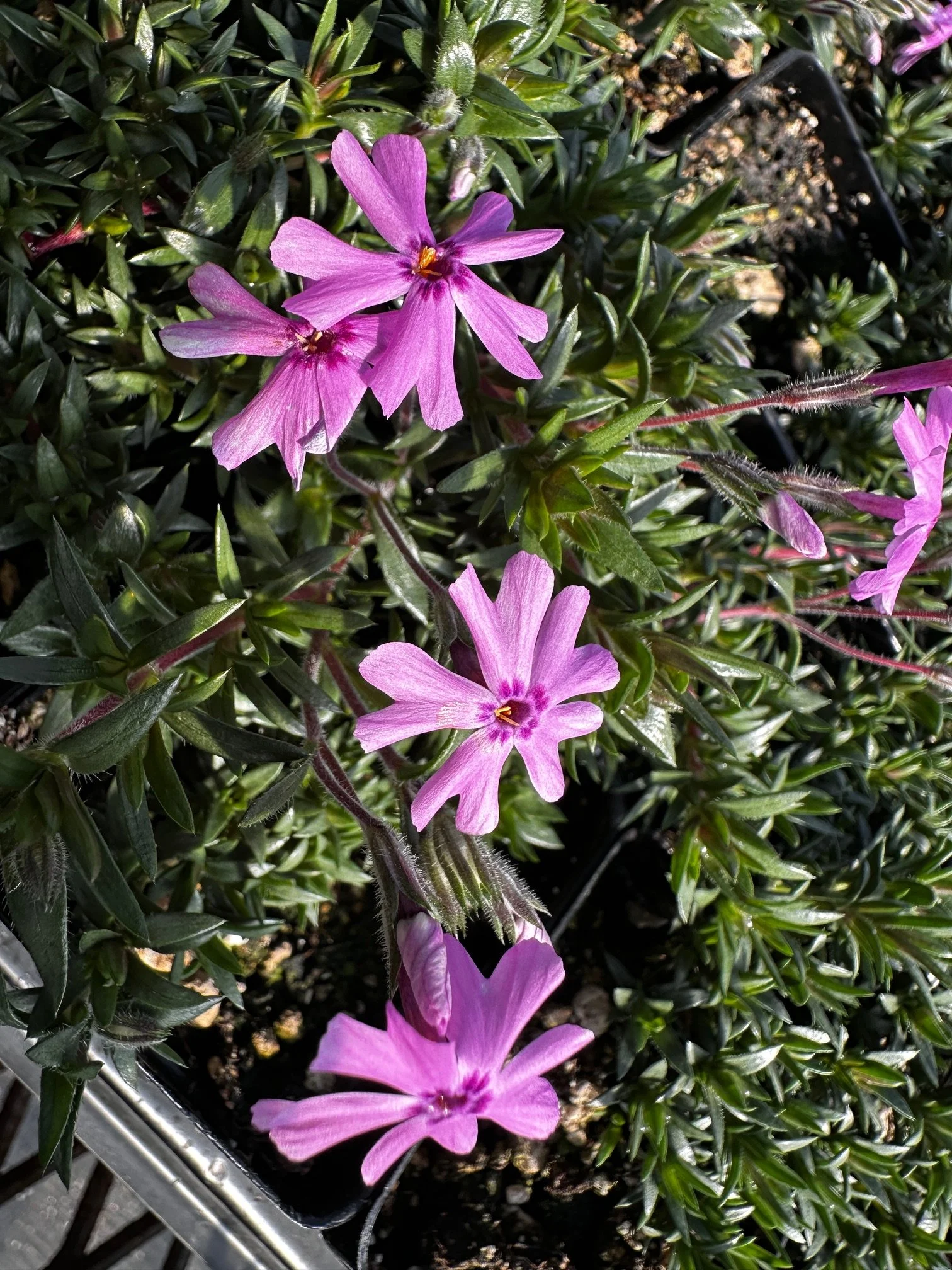
Phlox ‘Rice Creek’ is a compact, mat-forming selection of creeping phlox believed to be derived from western North American alpine and subalpine species complexes, particularly those centered around Phlox diffusa and related taxa native to rocky slopes, open conifer woodlands, and high-elevation screes. It is named for Rice Creek Nursery, in Minnesota where it was selected and introduced into specialist rock garden cultivation.
It forms a dense, evergreen to semi-evergreen cushion of fine, needle-like foliage on tightly interwoven stems that creep across the soil surface and root as they spread. The result is a low, resilient mat that is especially effective for covering stones, spilling over rock edges, and knitting together crevice plantings.
In spring, the plant is covered in a profusion of small, five-petaled flowers in soft lavender to lilac-pink tones, often with a faint eye and a subtle sheen in bright light. The bloom is typically abundant enough to create a near-continuous floral carpet, making it one of the more showy selections within the creeping phlox group.
In cultivation, Phlox ‘Rice Creek’ performs best in full sun and sharply drained, lean soils, where it excels in rock gardens, alpine troughs, and dry slopes. It requires excellent drainage and good air circulation, and is intolerant of heavy or persistently wet soils, particularly in winter.
Hardy in USDA Zones 4–7, this selection is valued for its reliable flowering, tight mat-forming habit, and adaptability to difficult, rocky garden conditions.
Phlox ‘Rice Creek’ is a compact, mat-forming selection of creeping phlox believed to be derived from western North American alpine and subalpine species complexes, particularly those centered around Phlox diffusa and related taxa native to rocky slopes, open conifer woodlands, and high-elevation screes. It is named for Rice Creek Nursery, in Minnesota where it was selected and introduced into specialist rock garden cultivation.
It forms a dense, evergreen to semi-evergreen cushion of fine, needle-like foliage on tightly interwoven stems that creep across the soil surface and root as they spread. The result is a low, resilient mat that is especially effective for covering stones, spilling over rock edges, and knitting together crevice plantings.
In spring, the plant is covered in a profusion of small, five-petaled flowers in soft lavender to lilac-pink tones, often with a faint eye and a subtle sheen in bright light. The bloom is typically abundant enough to create a near-continuous floral carpet, making it one of the more showy selections within the creeping phlox group.
In cultivation, Phlox ‘Rice Creek’ performs best in full sun and sharply drained, lean soils, where it excels in rock gardens, alpine troughs, and dry slopes. It requires excellent drainage and good air circulation, and is intolerant of heavy or persistently wet soils, particularly in winter.
Hardy in USDA Zones 4–7, this selection is valued for its reliable flowering, tight mat-forming habit, and adaptability to difficult, rocky garden conditions.