
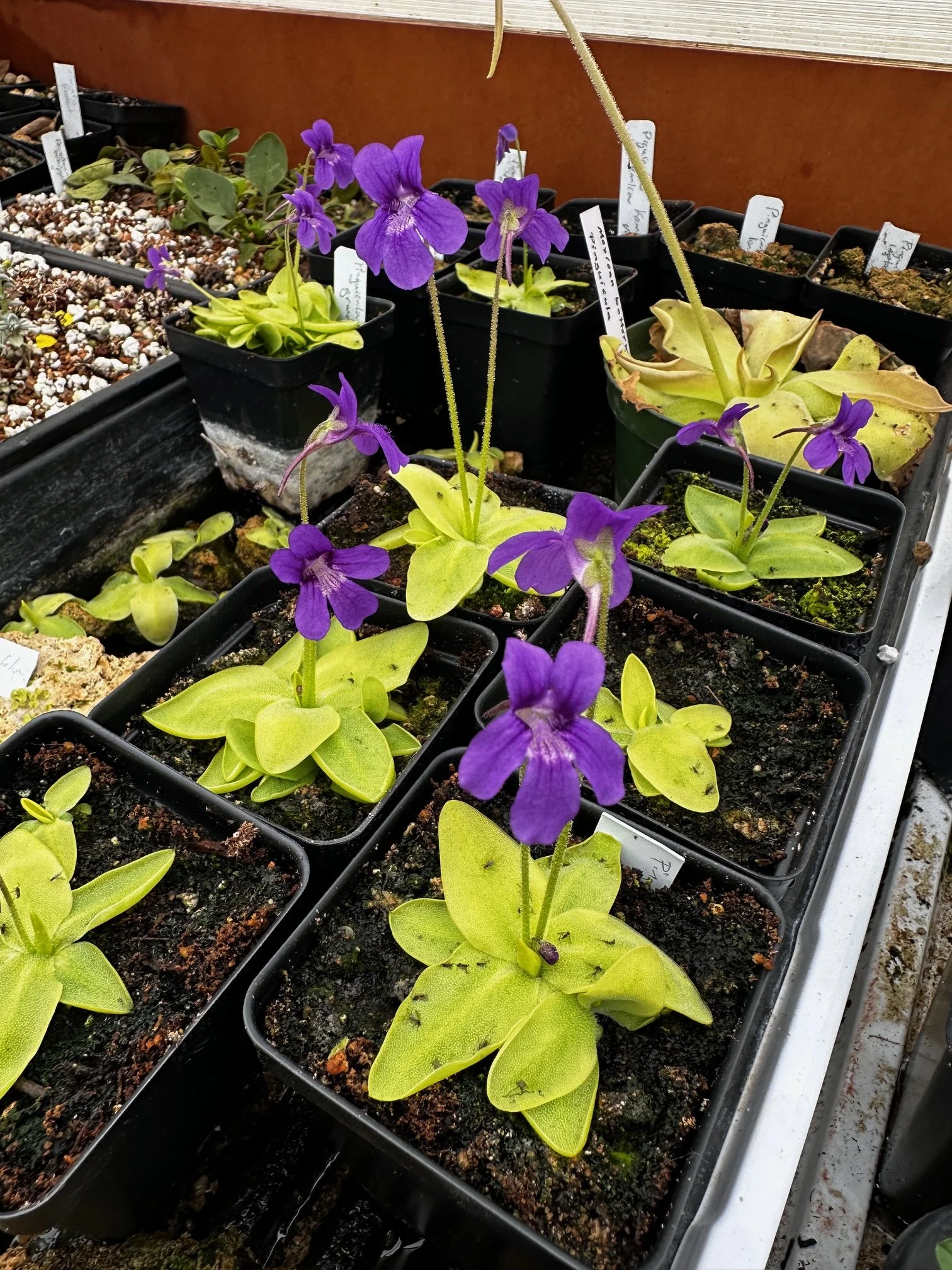
You guys have no idea how long I have been trying to get ahold of some of the hardy butterworts! This one is native to western Europe, particularly found in Ireland, France, and parts of the Iberian Peninsula, where it inhabits wet meadows, seepage slopes, calcareous flushes, and mossy spring areas. This carnivorous perennial forms a low rosette of soft, light green leaves that are slightly succulent and covered in glandular hairs which secrete a sticky mucilage used to capture small insects, supplementing its nutrition in nutrient-poor habitats.
In late spring to early summer, it produces elegant, upright stems bearing large, violet-purple to lavender flowers with a distinctly two-lipped form and a bright yellow-white throat. The blooms are notably large for the genus, giving the species its name, and rise well above the sticky rosette in a delicate but striking display.
In cultivation, it thrives in consistently moist, cool conditions with very low fertility. It is best grown in acidic to neutral, peaty or mossy substrates kept evenly damp, often in alpine troughs, bog gardens, or specialized carnivorous plant settings. It appreciates full sun to light shade, provided its roots remain cool and wet.
Thank goodness for my friend Janice Currie in Victoria! She got me not only this plant but some tufa to get it established on and now I have this and a few other alpine species from the European Mountains that are getting established.
Hardy in USDA Zones 5–8 with adequate winter moisture protection and stable cold conditions, Pinguicula grandiflora is valued both for its refined floral beauty and its subtle, insect-catching foliage, making it a distinctive choice for collectors of alpine and moisture-loving specialty plants. Still bulking these up so 1 per customer and I’m sorry about the price, I really am, but I shopped around and this is what the are going for.
You guys have no idea how long I have been trying to get ahold of some of the hardy butterworts! This one is native to western Europe, particularly found in Ireland, France, and parts of the Iberian Peninsula, where it inhabits wet meadows, seepage slopes, calcareous flushes, and mossy spring areas. This carnivorous perennial forms a low rosette of soft, light green leaves that are slightly succulent and covered in glandular hairs which secrete a sticky mucilage used to capture small insects, supplementing its nutrition in nutrient-poor habitats.
In late spring to early summer, it produces elegant, upright stems bearing large, violet-purple to lavender flowers with a distinctly two-lipped form and a bright yellow-white throat. The blooms are notably large for the genus, giving the species its name, and rise well above the sticky rosette in a delicate but striking display.
In cultivation, it thrives in consistently moist, cool conditions with very low fertility. It is best grown in acidic to neutral, peaty or mossy substrates kept evenly damp, often in alpine troughs, bog gardens, or specialized carnivorous plant settings. It appreciates full sun to light shade, provided its roots remain cool and wet.
Thank goodness for my friend Janice Currie in Victoria! She got me not only this plant but some tufa to get it established on and now I have this and a few other alpine species from the European Mountains that are getting established.
Hardy in USDA Zones 5–8 with adequate winter moisture protection and stable cold conditions, Pinguicula grandiflora is valued both for its refined floral beauty and its subtle, insect-catching foliage, making it a distinctive choice for collectors of alpine and moisture-loving specialty plants. Still bulking these up so 1 per customer and I’m sorry about the price, I really am, but I shopped around and this is what the are going for.