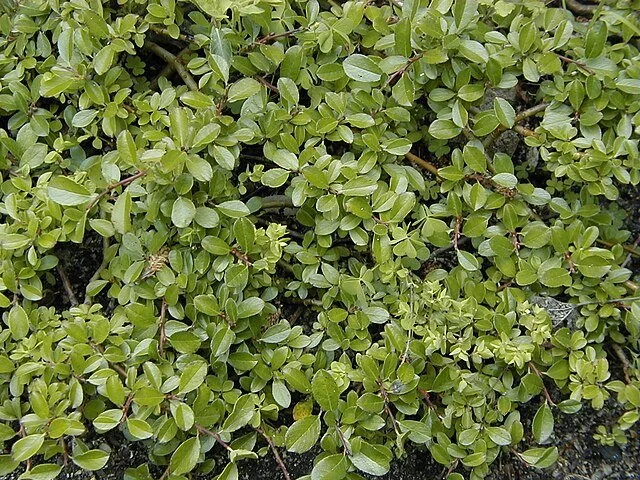
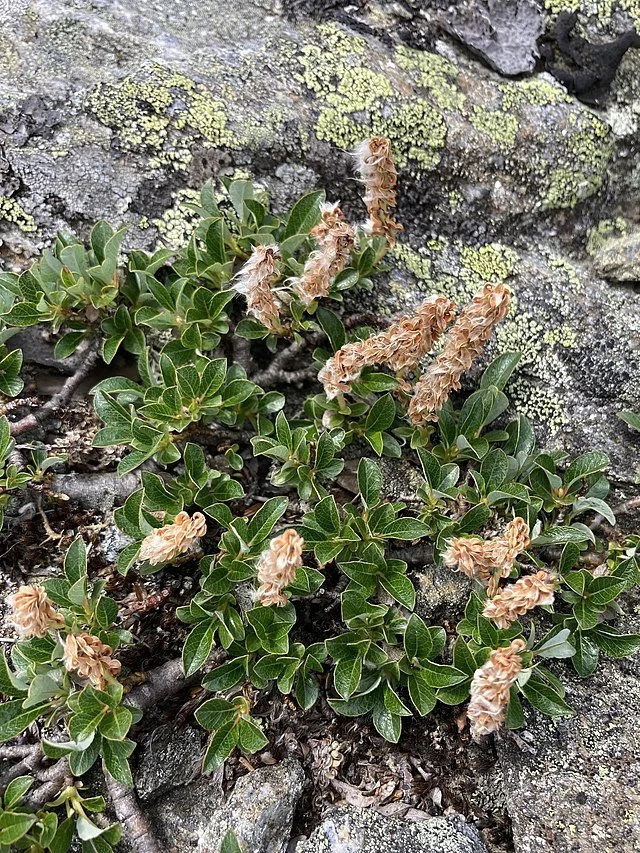
Salix uva-ursi is a dwarf, creeping willow forming dense, ground-hugging mats of wiry stems that root as they spread, creating slowly expanding carpets across cold, open ground. Native to arctic and alpine regions of northern Europe, Asia, and North America, it is typically found in tundra, windswept screes, and moist but sharply drained gravelly slopes where few woody plants can persist. This is one of the best alpine mat forming willows I have ever seen.
The foliage is small, rounded to elliptic, and often glossy, emerging along the prostrate stems to create a tight, leafy weave just above the substrate. In spring, it produces short, upright catkins before or with the leaves, subtle but characteristic of the willow family, offering an understated seasonal accent rather than showy bloom.
Salix uva-ursi is particularly valued in alpine and rock garden cultivation for its extreme hardiness and naturalistic, mat-forming habit. It excels in crevice gardens, troughs, and gravel plantings where it can root into pockets of mineral soil and slowly knit together over time. Its growth is restrained but persistent, making it useful for stabilizing scree-like compositions or softening stone edges.
Best grown in full sun to light shade in cool climates with consistently moist but well-drained soil, it is fully adapted to cold exposure and wind, thriving where summer heat is minimal. Hardy in USDA Zones approximately 1–6, this is a plant of northern character—quiet, resilient, and perfectly suited to miniature landscapes that echo tundra and alpine fell fields.
In terms of USDA hardiness zones, it is generally hardy in zones 2 to 6
Salix uva-ursi is a dwarf, creeping willow forming dense, ground-hugging mats of wiry stems that root as they spread, creating slowly expanding carpets across cold, open ground. Native to arctic and alpine regions of northern Europe, Asia, and North America, it is typically found in tundra, windswept screes, and moist but sharply drained gravelly slopes where few woody plants can persist. This is one of the best alpine mat forming willows I have ever seen.
The foliage is small, rounded to elliptic, and often glossy, emerging along the prostrate stems to create a tight, leafy weave just above the substrate. In spring, it produces short, upright catkins before or with the leaves, subtle but characteristic of the willow family, offering an understated seasonal accent rather than showy bloom.
Salix uva-ursi is particularly valued in alpine and rock garden cultivation for its extreme hardiness and naturalistic, mat-forming habit. It excels in crevice gardens, troughs, and gravel plantings where it can root into pockets of mineral soil and slowly knit together over time. Its growth is restrained but persistent, making it useful for stabilizing scree-like compositions or softening stone edges.
Best grown in full sun to light shade in cool climates with consistently moist but well-drained soil, it is fully adapted to cold exposure and wind, thriving where summer heat is minimal. Hardy in USDA Zones approximately 1–6, this is a plant of northern character—quiet, resilient, and perfectly suited to miniature landscapes that echo tundra and alpine fell fields.
In terms of USDA hardiness zones, it is generally hardy in zones 2 to 6