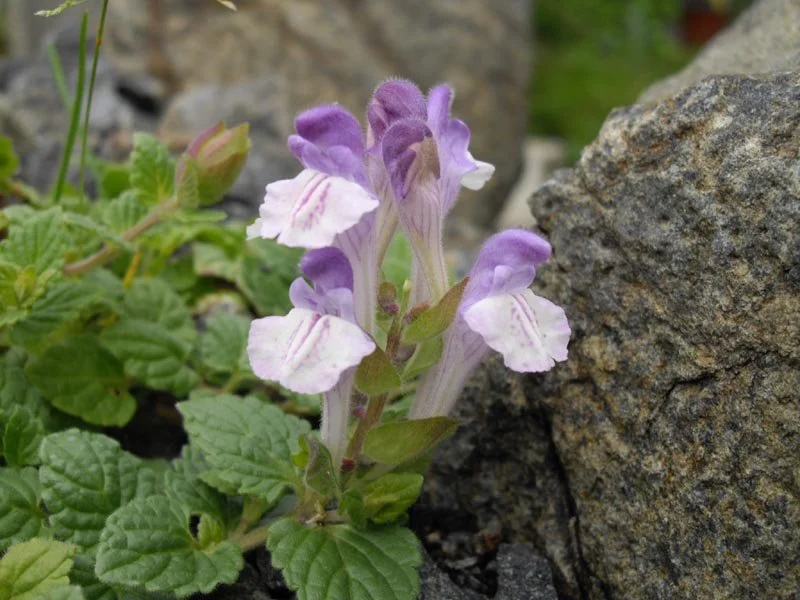
‘Romana’ tends to hold a more consistently neat mound, making it especially useful in designed rock gardens and trough plantings where structure matters year-round. The flowers are held just above the foliage in short spikes, giving a clean, layered look rather than a loose or sprawling effect. This makes it particularly effective when planted in groups among limestone scree or tight crevice plantings. It features low-growing foliage and upright spikes of violet-blue flowers with pale markings, blooming in summer. Ideal for rock gardens, troughs, or the front of borders. Thrives in well-drained, moderately fertile soil in full sun to partial shade.
Its origins in the central Apennines give it a natural preference for cool summers, sharp drainage, and lean, mineral soils. In cultivation, it is appreciated not only for its floral intensity but also for its restraint—never aggressive, never coarse, just quietly precise. Compared with standard Scutellaria alpina, the ‘Romana’ form is generally considered more garden-worthy for small-scale alpine compositions where refinement and density are valued over wild sprawl.
Seed grown, may have color variability as this is a notoriously promiscuous genus.
Drought-tolerant once established.
Hardy to USDA zone 5 (–20°F / –29°C).
‘Romana’ tends to hold a more consistently neat mound, making it especially useful in designed rock gardens and trough plantings where structure matters year-round. The flowers are held just above the foliage in short spikes, giving a clean, layered look rather than a loose or sprawling effect. This makes it particularly effective when planted in groups among limestone scree or tight crevice plantings. It features low-growing foliage and upright spikes of violet-blue flowers with pale markings, blooming in summer. Ideal for rock gardens, troughs, or the front of borders. Thrives in well-drained, moderately fertile soil in full sun to partial shade.
Its origins in the central Apennines give it a natural preference for cool summers, sharp drainage, and lean, mineral soils. In cultivation, it is appreciated not only for its floral intensity but also for its restraint—never aggressive, never coarse, just quietly precise. Compared with standard Scutellaria alpina, the ‘Romana’ form is generally considered more garden-worthy for small-scale alpine compositions where refinement and density are valued over wild sprawl.
Seed grown, may have color variability as this is a notoriously promiscuous genus.
Drought-tolerant once established.
Hardy to USDA zone 5 (–20°F / –29°C).