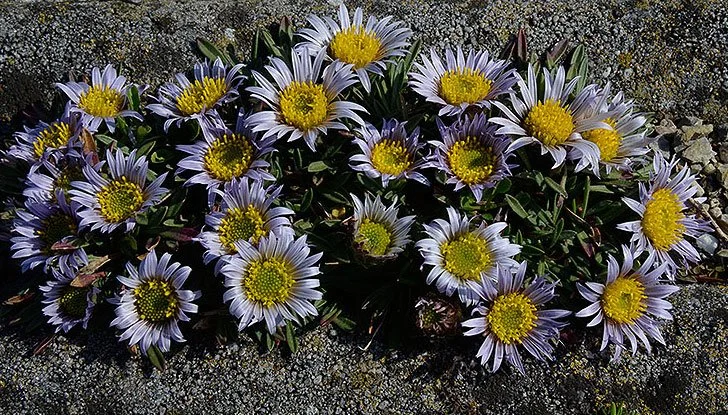
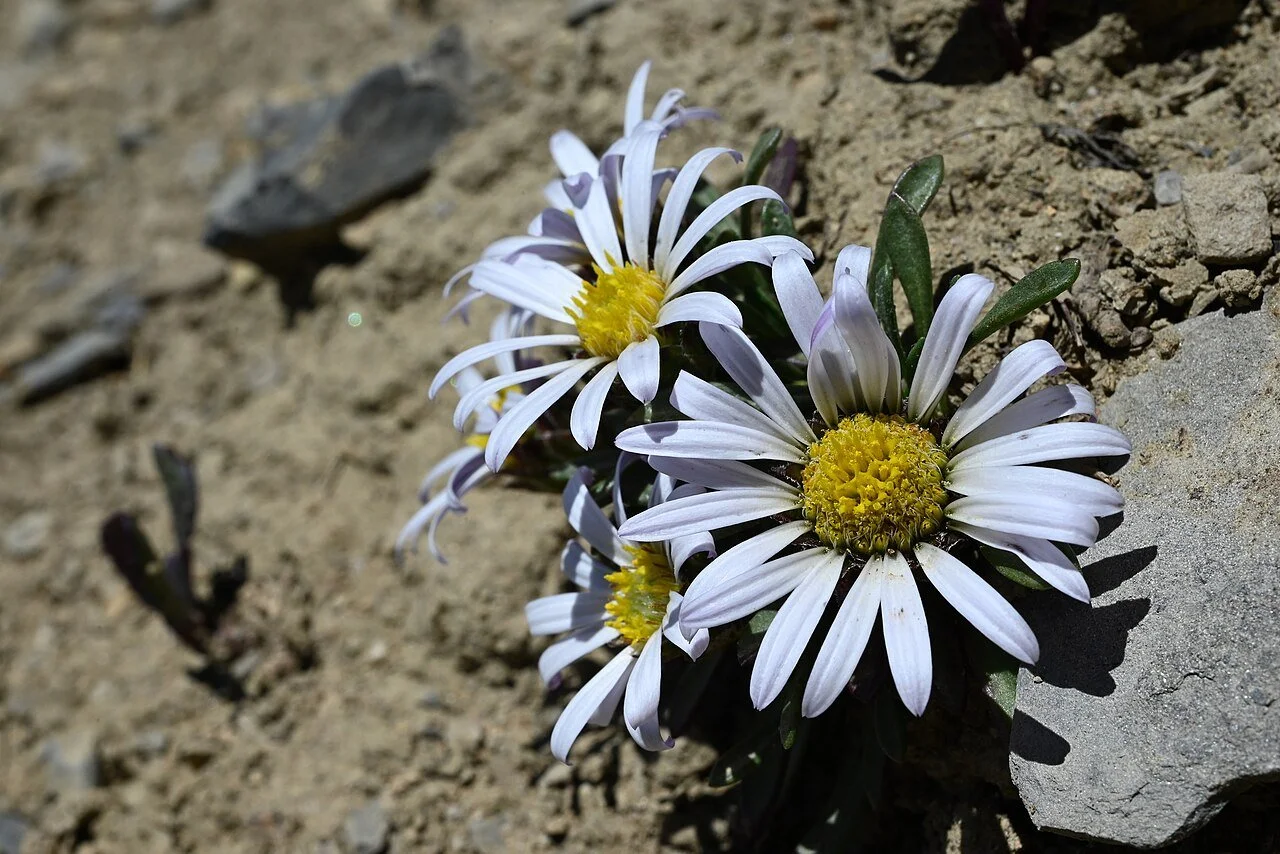
A choice alpine daisy from the high mountains of Colorado, Townsendia rothrockii forms compact, densely leafy rosettes from a stout taproot and caudex. In late spring and summer, the rosettes are topped with relatively large flower heads, the white to lavender to blue-violet rays surrounding a golden-yellow center. The flower heads can reach nearly 3 cm across, making them particularly showy for such a small alpine.
Rothrock’s Townsend daisy is native to southwestern and central Colorado, where it grows in montane to alpine habitats, including open rocky slopes, talus, ridges, passes, alpine meadows, fellfields and exposed rock outcrops. Herbarium collections document it at elevations around 2,500–4,000 m, including limestone and other rocky substrates.
This is an excellent plant for the alpine rock garden, trough or dry scree garden. Give it full sun and exceptionally sharp drainage, preferably in a gritty, mineral soil. Its compact rosette and substantial blue-lavender flowers make it especially attractive among rocks, while its adaptation to exposed, high-elevation conditions makes it an intriguing choice for collectors of North American alpine plants
A choice alpine daisy from the high mountains of Colorado, Townsendia rothrockii forms compact, densely leafy rosettes from a stout taproot and caudex. In late spring and summer, the rosettes are topped with relatively large flower heads, the white to lavender to blue-violet rays surrounding a golden-yellow center. The flower heads can reach nearly 3 cm across, making them particularly showy for such a small alpine.
Rothrock’s Townsend daisy is native to southwestern and central Colorado, where it grows in montane to alpine habitats, including open rocky slopes, talus, ridges, passes, alpine meadows, fellfields and exposed rock outcrops. Herbarium collections document it at elevations around 2,500–4,000 m, including limestone and other rocky substrates.
This is an excellent plant for the alpine rock garden, trough or dry scree garden. Give it full sun and exceptionally sharp drainage, preferably in a gritty, mineral soil. Its compact rosette and substantial blue-lavender flowers make it especially attractive among rocks, while its adaptation to exposed, high-elevation conditions makes it an intriguing choice for collectors of North American alpine plants