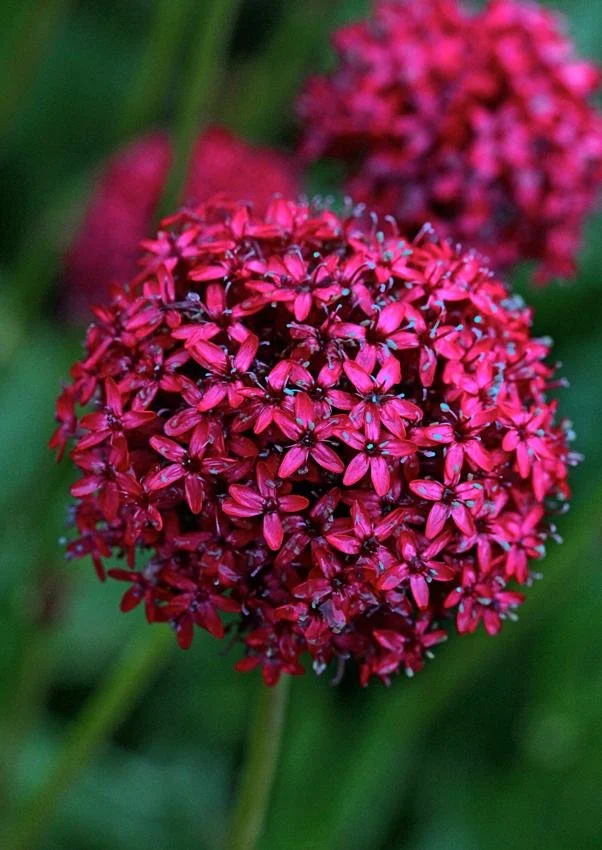
A striking Balkan perennial and an excellent plant for the rock garden, Viscaria asterias forms compact clumps of silvery-green foliage, sending up upright stems topped with rounded heads of intensely dark pink to red flowers. The flowers are notably fragrant, adding an unexpected bonus to this handsome little plant. It reaches roughly 12 inches tall and is particularly effective planted among rocks or toward the front of a sunny border.
Native to southeastern Albania, Greece, and northwestern Bulgaria, Viscaria asterias is a plant of the Balkan Peninsula and belongs to the carnation family, Caryophyllaceae. It was formerly known as Silene asterias, a name still frequently encountered in horticulture; the current accepted name is Viscaria asterias. I rather like the common name of Cherry drumsticks, but Bulgarian catchfly works as well.
The fragrant summer flowers are attractive to insect pollinators, making this an excellent addition to a pollinator-friendly rock garden. Grow in full sun in sandy, gritty, or well-drained soil. Hardy to approximately Zone 5–8.
A striking Balkan perennial and an excellent plant for the rock garden, Viscaria asterias forms compact clumps of silvery-green foliage, sending up upright stems topped with rounded heads of intensely dark pink to red flowers. The flowers are notably fragrant, adding an unexpected bonus to this handsome little plant. It reaches roughly 12 inches tall and is particularly effective planted among rocks or toward the front of a sunny border.
Native to southeastern Albania, Greece, and northwestern Bulgaria, Viscaria asterias is a plant of the Balkan Peninsula and belongs to the carnation family, Caryophyllaceae. It was formerly known as Silene asterias, a name still frequently encountered in horticulture; the current accepted name is Viscaria asterias. I rather like the common name of Cherry drumsticks, but Bulgarian catchfly works as well.
The fragrant summer flowers are attractive to insect pollinators, making this an excellent addition to a pollinator-friendly rock garden. Grow in full sun in sandy, gritty, or well-drained soil. Hardy to approximately Zone 5–8.